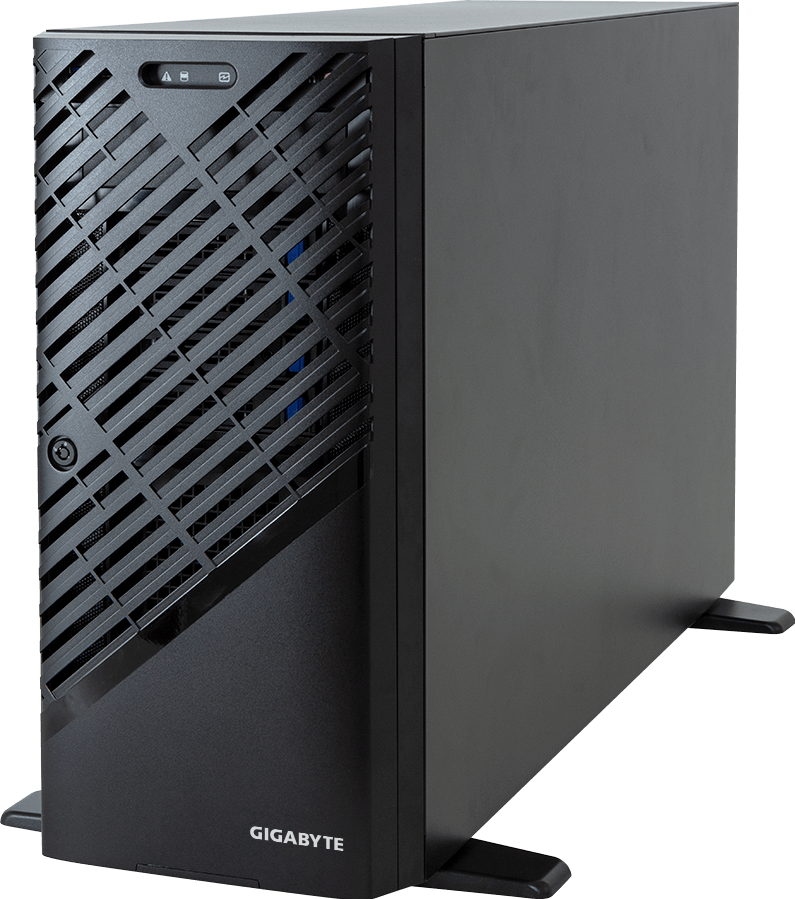
Tower Server

Tower servers, available in mid to full-size configurations, are versatile for various office environments. Their diverse architecture and expansion capabilities ensure reliability and flexibility for critical tasks. Paired with the GIGABYTE Management Console (GMC), they provide enterprise-level system maintenance.

Applications Include :

  • Machine Learning
  • Software Development
  • Content Creation
  • Rendering
GIGABYTE Tower Server
Filter
Platform
Cooling Type
Processor Vendor
CPU Series
CPU Type
CPUs
Form Factor
GPU Type
GPUs
LAN Speed
LAN Ports
DIMM Slots
Drive Bays
Certifications
CPU Power
Application

Tower Server FAQ

What is a tower server?

A tower server is a standalone server that resembles a desktop PC but is built to handle business workloads. It provides dedicated computing resources and flexible hardware expansion without requiring a server rack.
Unlike desktop PCs designed for individual use, tower servers support multiple users and shared services. They may feature server-grade processors, ECC memory, and remote management capabilities for greater reliability and continuous operation.
Tower servers help small and medium-sized businesses (SMBs) run essential IT services, including file sharing, data backup, databases, and virtualization. Depending on the configuration, they can also handle demanding workloads such as rendering and AI applications.
Tower servers are standalone systems suited for smaller deployments, while rack servers are designed to fit into standardized racks, allowing multiple servers to be installed, organized, and managed in a centralized environment.