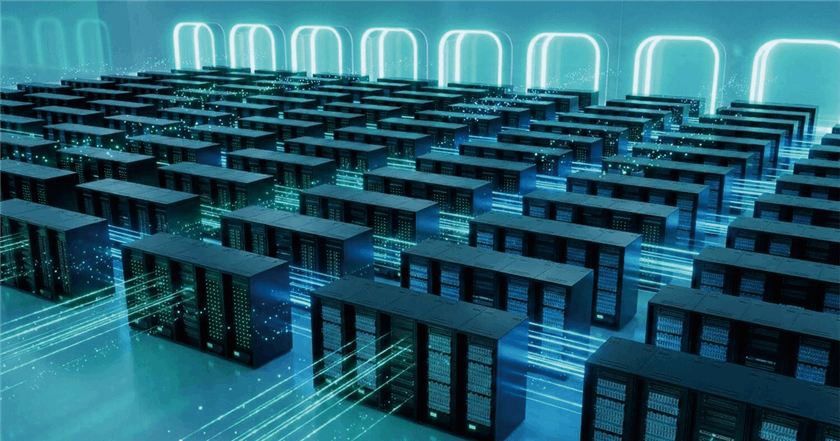
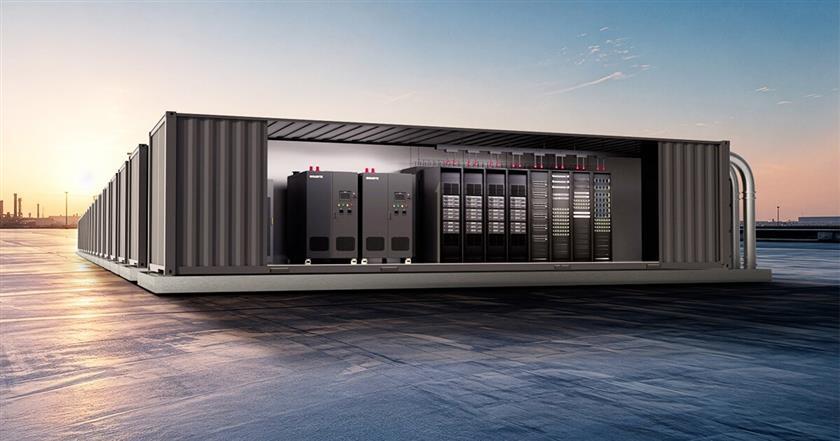
September 22, 2026 - Giga Computing, a subsidiary of GIGABYTE, a global provider of advanced computing solutions, today announced the establishment of GAIFA (GIGABYTE AI Factory Accelerator), its first proprietary AI computing center, located in New Taipei City, Taiwan. GAIFA is not only Giga Computing's first proprietary AI computing center, but it is also a key validation facility that extends the company's server, liquid cooling, and data center design expertise into AI computing environments, strengthening Giga Computing's practical capabilities in rack-scale AI Infrastructure and AIDC integration.
GAIFA is built around a modular rack-scale design, starting with a deployment of six racks for compute, storage, and networking. The initial phase has a planned power capacity of 700 kW, with additional capacity to be planned in future phases based on operational needs. The facility employs direct liquid cooling technology, providing a real-world environment to validate compute, power, and thermal management as integrated systems.
For AI compute infrastructure, GAIFA deploys:
- Two racks of the NVIDIA GB300 NVL72,
- One rack of G4L4-SD3-LAX7 DLC servers equipped with NVIDIA HGX™ B300,
- Additional platforms: XL44-SX2-AAS1 equipped with NVIDIA RTX™ PRO 6000 GPUs and liquid-cooled B683-Z80-LAS1 with AMD EPYC™ CPUs.
The GB300 NVL72 is a highly integrated rack-scale AI infrastructure that unifies GPU, CPU, high-speed interconnects, and networking into a single liquid cooled system for trillion-parameter LLM training and agentic AI workloads. The HGX B300 platform delivers flexible high-density GPU server deployment for enterprise AI workloads, while the RTX PRO 6000 platform targets visual computing, generative AI inference, and professional computing scenarios. Rounding out the lineup, the 6U, 20-socket EPYC-based blade platform excels in dense compute for HPC, virtualization, and AI inference workloads. Deploying all compute racks side by side lets GAIFA validate a full range of AI workloads, from large-scale training and enterprise inference to professional visual computing, in a single environment.
GAIFA's scope extends beyond hardware, covering the full process from facility planning, power configuration, storage architecture, and liquid cooling system integration to on-site deployment and validation. It reflects Giga Computing's engineering capabilities across the data center stack. As AI compute demands continue to rise and enterprise requirements shift from single-device performance to overall data center energy efficiency and stability, GAIFA is Giga Computing's direct response to this emerging trend in the market.
GAIFA will build on Giga Computing's existing Proof of Concept (POC) service, helping customers complete multiple validations in a rack-scale environment before deploying AI infrastructure at scale, covering:
Across both SP7 and SP8, Giga Computing offers a comprehensive server portfolio that pairs each socket with the workloads it was designed for, spanning rack, blade, GPU, and edge systems. For the SP7 socket, several notable additions have been made to the GIGABYTE lineup. The new R165-DG2-CS1 is a single-socket rack server that uses closed-loop liquid cooling to support SP7's maximum 256-core configuration at max power within a 1U compact chassis. The B685-D80-LS1 is a 6U ten-node blade server with direct liquid cooling, purpose-built for high-density HPC deployments.
Shipments of GIGABYTE Servers, Powered by AMD EPYC 9006 Series Processors
9006 SP7 systems will begin shipments on day one along with AMD in November 2026. [SS1.1] 9006 SP8 systems will begin shipments in March 2027.
- Compute Performance: GPU, CPU, and overall system throughput
- Rack Power Density: power requirements and configuration for high-density AI racks
- Liquid Cooling Thermal Performance: cooling capacity, flow rate, and thermal load
- Thermal Management: end-to-end thermal optimization for high-power GPU systems
- Network Performance: high-speed interconnects and east-west networking for AI clusters
- System Compatibility: integration across compute, network, and cooling components
- Deployment and Validation: real-world rack deployment, tuning, and validation
- L12 Deployment: global service and cluster-level validation
By completing validation in a real-world environment before deployment, customers gain earlier insight into how their AI infrastructure will actually perform across compute, thermal management, power, software stack, and system compatibility. This reduces the technical and engineering risks of large-scale deployment and shortens the path from proof of concept through design validation to full production. It is also central to how Giga Computing continues to deepen its relationships with customers.
"GAIFA is not just Giga Computing's own AI compute center, it is a real-world proving ground where we validate AI infrastructure together with our customers," said Daniel Hou, General Manager at Giga Computing. "We want customers to be able to validate the performance, thermal management, and stability of their systems before they deploy AI compute at scale, working alongside them every step of the way to reduce deployment risk and shorten time to production."
Giga Computing will continue to invest in liquid cooling, rack-scale integration, and data center engineering, extending the experience gained from building GAIFA into additional markets to help customers accelerate the buildout of AI-ready infrastructure. Detailed specifications and operational information will follow once GAIFA is complete.
For queries or more information, please contact sales.