Computing Cluster
What is it?
A computing cluster is a set of computers working together like a single system, providing better performance, availability, and cost efficiency than a comparable mainframe computer. It is distinguished from grid computing in that grid computers are assigned different tasks, whereas a computing cluster pools its combined computational power to achieve the same goal.
Computers in the cluster, referred to as "nodes", may be consumer-grade products like a typical PC, or highly customized enterprise solutions. The prowess of the cluster is reflected in its number of nodes; in turn, these nodes are measured by their number of processors, as well as how many cores and threads are contained in each processor.
Generally, there is a single "control" or "head" node, through which the user interfaces with the cluster. The remaining nodes are "compute nodes". All nodes are interconnected via high-speed networks. Cluster management software is used to schedule workloads and provide coordination.
Computers in the cluster, referred to as "nodes", may be consumer-grade products like a typical PC, or highly customized enterprise solutions. The prowess of the cluster is reflected in its number of nodes; in turn, these nodes are measured by their number of processors, as well as how many cores and threads are contained in each processor.
Generally, there is a single "control" or "head" node, through which the user interfaces with the cluster. The remaining nodes are "compute nodes". All nodes are interconnected via high-speed networks. Cluster management software is used to schedule workloads and provide coordination.
Why do you need it?
Establishing a computing cluster can be a major step toward achieving high performance computing (HPC), high availability (HA), or load balancing capabilities. The advantages are many, including faster processing speeds; larger storage capacities; better data security, scalability, and cost efficiency. Access to such a solution may improve productivity in both the public and private sectors.
Public sector: Government agencies around the world have set up dedicated computing clusters to upgrade their services, especially with regard to public safety and welfare. Examples include simulating natural disasters to improve forecast accuracy and relief efforts; analyzing genomics to combat a dangerous pandemic; or even something as mundane as monitoring highway traffic so everyone can get home in time for the holidays.
Private sector: Computing clusters have opened up boundless opportunities for businesses. Some examples include: more efficient exploration in the energy sector; greater security and profitability in the finance industry; more creative special effects and performances in showbiz. The ease with which a computing cluster can be scaled up and scaled out means a smaller company can set up a modest cluster early on, and then gradually expand the cluster as business grows.
Public sector: Government agencies around the world have set up dedicated computing clusters to upgrade their services, especially with regard to public safety and welfare. Examples include simulating natural disasters to improve forecast accuracy and relief efforts; analyzing genomics to combat a dangerous pandemic; or even something as mundane as monitoring highway traffic so everyone can get home in time for the holidays.
Private sector: Computing clusters have opened up boundless opportunities for businesses. Some examples include: more efficient exploration in the energy sector; greater security and profitability in the finance industry; more creative special effects and performances in showbiz. The ease with which a computing cluster can be scaled up and scaled out means a smaller company can set up a modest cluster early on, and then gradually expand the cluster as business grows.
How is GIGABYTE helpful?
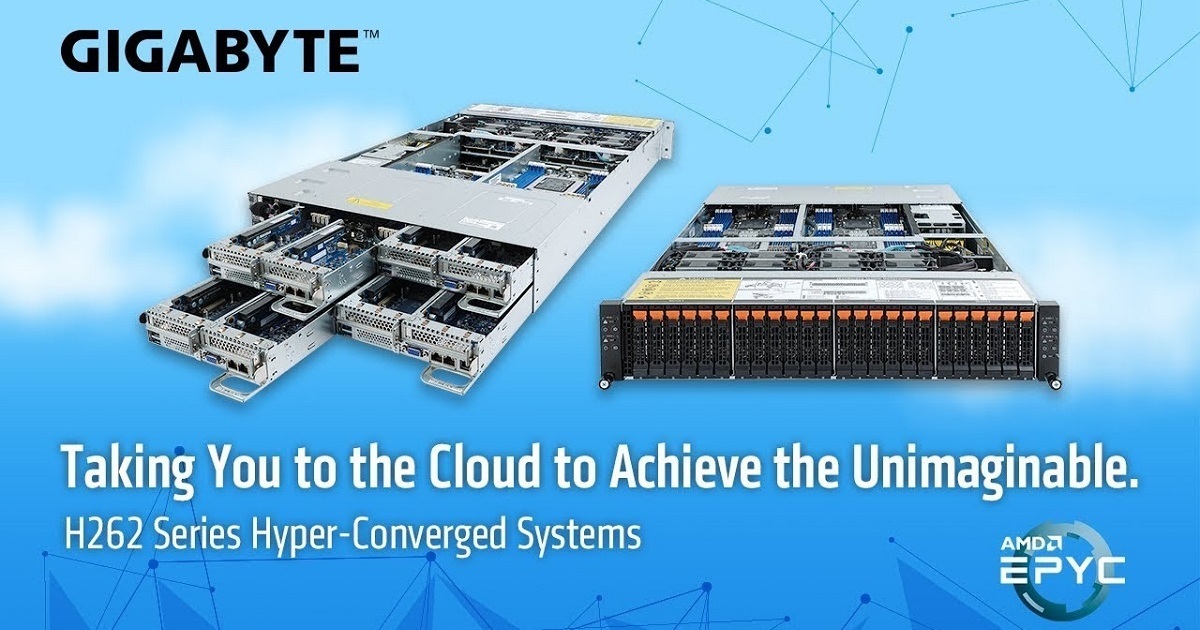
GIGABYTE's array of server solutions can be utilized as head or compute nodes within any computing cluster, depending on the user scenario. The H-Series High Density Servers and G-Series GPU Servers are well-suited for the head node, due to their industry-leading ultra-high density design, impressive storage capacity, and the outstanding performance of their Intel® Xeon® or AMD EPYC™ processors. The W-Series Tower Servers are excellent choices for the compute nodes, since they are housed inside stand-alone chassis that clients can customize or expand as their needs change. Rack Servers are also suitable for business-critical workloads; they come in a wide range of configurations, from 1U to 5U. The servers can be linked together via interconnects such as Ethernet, Infiniband, or Omni-Path.