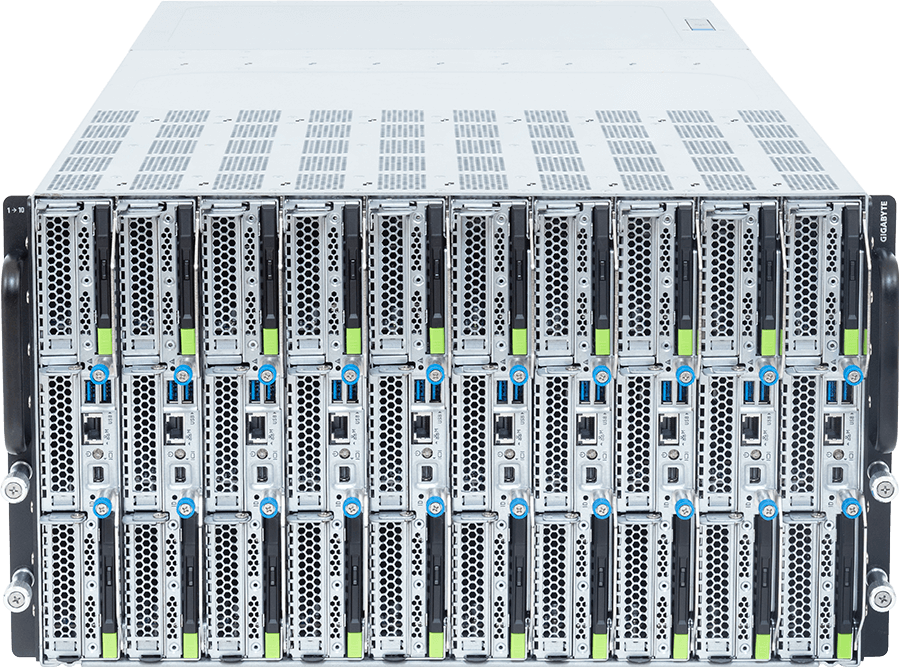
High Density Server

Multi-node servers enhance performance by distributing workloads across nodes, ensuring reliability and scalability. Key benefits include redundancy, simplified management, lower TCO, and improved efficiency.

Applications Include :

  • High-Performance Computing (HPC)
  • Hyper-Converged Infrastructure (HCI)
  • Edge Computing
  • File Storage
GIGABYTE High Density Server
Filter
Platform
Cooling Type
Processor Vendor
CPU Series
CPU Type
CPUs
Form Factor
GPU Type
GPUs
LAN Speed
LAN Ports
DIMM Slots
Drive Bays
Certifications
CPU Power
Application

High Density Server FAQ

What is a high-density server?

A high-density server uses a multi-node architecture to integrate multiple independent computing nodes within a single chassis. Each node can operate independently while sharing power and cooling resources, depending on the system design, to maximize computing density within limited space.
High-density servers accommodate more computing nodes within limited rack space, improving space utilization in data centers. By sharing power and cooling resources across multiple nodes, they can also improve energy efficiency and help lower total cost of ownership (TCO).

High-density servers are well suited for workloads that require numerous computing nodes and distributed processing, including high-performance computing (HPC), hyperconverged infrastructure (HCI), cloud computing, and virtualization. Depending on the system configuration, they can also support file storage applications.
Traditional rack servers typically house a single computing system with dedicated power and cooling components. In contrast, high-density servers integrate multiple computing nodes into a shared chassis, reducing the physical space required per node and making them better suited for large-scale, centralized deployments.