What Is Deep Learning? Applications of DNN (Deep Neural Network) Technology
Perspective by GIGABYTE
Artificial intelligence is a broad field of study. The major technologies discussed today can generally be viewed as a hierarchy: Artificial Intelligence → Machine Learning → Artificial Neural Networks → Deep Learning, or deep neural networks → Convolutional Neural Networks.
Deep Learning: Processing Large and Complex Data
Over the past three decades, the race to build the world’s fastest supercomputer and rank on the TOP500 list has become not only an important measure of technological capability, but also a symbol of national strength. Even the number of systems a country has on the list can, to some extent, reflect its position in the global technology landscape.
However, theoretical computing performance alone does not determine the real value of a supercomputer.
The idea is similar to Software-Defined Networking (SDN), which focuses on improving the flexibility and efficiency of existing network infrastructure rather than simply supporting the complete OpenFlow standard. In many cases, existing network switching chips can be enhanced with selected SDN capabilities to meet practical application needs.
The same applies to supercomputers. High theoretical performance is important, but what matters even more is how quickly a system can be built, how efficiently it can be deployed, and how easily its computing resources can be applied to productive workloads.
Many supercomputer users are researchers and R&D professionals rather than IT specialists. Therefore, creating an environment that is easy to manage and use is just as important as providing high computing performance.
This is also why mainstream supercomputer architectures have gradually moved away from systems that require specialized operating systems, applications, and development tools. Instead, they increasingly use general-purpose processors and computing platforms.
This approach helps reduce manufacturing costs, gives customers more flexibility in choosing suppliers, and provides access to a broader range of software. It also encourages knowledge sharing across the high-performance computing community and helps accelerate technological development.
As a result, many systems on the TOP500 list have been based on Intel x86 processors, while NVIDIA GPUs have contributed a growing amount of additional floating-point computing power.
What applies to supercomputing also applies to artificial intelligence. Google, which was not traditionally associated with the supercomputer market, announced that its third-generation Cloud TPU could deliver theoretical performance of up to 100 petaflops.
In other words, enterprises can now access supercomputer-class computing resources through the cloud. From this perspective, artificial intelligence can be considered one of the most important application trends in modern supercomputing.
Two Stages and Three Levels of Deep Learning
Artificial intelligence is a broad field. The technologies commonly discussed today can generally be divided into the following hierarchy:
Artificial Intelligence → Machine Learning → Artificial Neural Networks → Deep Learning → Convolutional Neural Networks
Machine learning can generally be divided into two stages: training and inference.
Machine learning can generally be divided into two stages: training and inference.
During training, machine learning techniques use large amounts of sample data to train an algorithm.
During inference, the trained algorithm is used to interpret and recognize real-world data in actual applications.
Convolutional Neural Networks (CNNs) are especially well suited to matrix operations and feature recognition. They are among the best-known and most widely used technologies in deep learning.
Consider a simple example: building an AI system that can recognize cats.
First, the system needs to learn different features of a cat, such as having a tail, pointed ears, or other visual characteristics.
Through a feature extraction process called convolution, the system converts these features into information that can be evaluated by the neural network.
This process involves multiple layers of an artificial neural network. For example, the first layer may identify basic shapes, the second layer may recognize edges and patterns, and the third layer may identify more specific features.
A pooling layer then reduces the amount of image data while preserving important features, helping improve processing efficiency.
Next comes backpropagation.
A large number of images are prepared to train the neural network. Through repeated trial and error, the network adjusts the weights assigned to different features based on whether its predictions are correct.
These weights determine how strongly each feature contributes to the final result. The network then combines this information to decide whether an image contains a cat.
Once the neural network has learned suitable weights, the trained model can be used for inference and prediction. It can then determine whether a small animal in front of the camera is a cat, a dog, or something else.
It is easy to understand why training requires significant computing resources and relatively high numerical precision.
Inference, on the other hand, can often be performed with lower precision and simpler integer calculations. This is why different levels of numerical precision are used across environments ranging from data centers to edge computing.
At their core, however, many of these workloads still rely heavily on matrix multiplication operations such as:
D = AB + C
Machine learning architectures can therefore be further divided into three levels:
Training in the data center:
Model training generally requires relatively high numerical precision. FP32 floating-point calculations are commonly used, although lower-precision formats can reduce the amount of data and improve performance. For example, Google’s second- and third-generation Cloud TPUs and NVIDIA GPUs support both FP16 and FP32 calculations.
Inference in the data center:
Cloud-based inference performs continuous, real-time calculations. Numerical precision can often be reduced further in exchange for higher performance, lower power consumption, and smaller data requirements. Google’s first-generation Cloud TPU is one example.
Inference at the edge:
Edge AI applications typically rely on low-power embedded ASICs. Google’s Edge TPU, for example, can perform inference using INT8 and INT16 integer formats.
Understanding these different levels makes it easier to determine where a particular “AI chip” fits, what types of workloads it can handle, and what its limitations are.
What Types of AI Chips Are There?
Chip manufacturers are actively developing products for the growing AI market.
These solutions include traditional CPUs, specialized CPUs such as Intel Xeon Phi, mobile CPUs and SoCs with integrated neural processing capabilities, GPUs, FPGAs, custom ASICs such as Google TPUs, and even processing-in-memory technologies.
There are also more experimental technologies, such as IBM TrueNorth and artificial neuron architectures.
Among these options, NVIDIA GPUs have become increasingly common in TOP500 systems and have accumulated years of software development resources, tools, and real-world applications.
For many AI and high-performance computing workloads, this mature ecosystem makes GPUs an attractive option.
What You Should Know About GPGPU?
The term GPU became widely recognized after NVIDIA introduced the GeForce 256, code-named NV10, on August 31, 1999.
Since then, GPU technology has evolved significantly.
The development of General-Purpose Computing on Graphics Processing Units, or GPGPU, went through several stages.
Between 1999 and 2006, Microsoft DirectX 9 introduced programmable shaders, laying the foundation for more flexible GPU computing.
From 2006 to 2009, DirectX 10 introduced the unified shader architecture, helping establish the SIMT computing model, which combines characteristics of SIMD and MIMD computing.
Between 2009 and 2010, support for IEEE 754 floating-point formats through DirectX 11 made GPUs more suitable for high-performance computing.
From 2010 to 2016, GPGPU programming interfaces and applications became increasingly mature and practical.
Starting around 2016, GPUs began playing an increasingly important role in artificial intelligence.
NVIDIA was involved throughout this development. In particular, the NVIDIA G80 microarchitecture and CUDA programming model, both introduced in 2006, played an important role in establishing GPUs as general-purpose floating-point computing platforms.
Today, NVIDIA GPUs are widely used in TOP500 systems, while products such as the DGX-2 demonstrate how GPU computing can be integrated into powerful standalone AI systems.
These achievements did not happen overnight. They are the result of more than a decade of continued development, software investment, and real-world deployment. This experience is reflected in both the number of available applications and NVIDIA’s position in the market.
An AI Server Is More Than a Server Full of GPUs
For enterprises that rely on high-performance computing, building a new AI or HPC environment requires more than simply maximizing computing performance.
Unlike academic institutions, enterprises must also consider existing applications, IT operations, system management, and overall usability.
Expensive computing infrastructure is rarely dedicated to just one user. It is usually a shared resource used by multiple teams and workloads.
This creates the need for effective resource allocation.
Organizations not only need more computing power, but also the ability to dynamically adjust system configurations based on different workload requirements.
Resources may need to be divided into different environments so multiple workloads can run at the same time. Enterprises also need to improve resource utilization while maintaining flexibility for future expansion.
For this reason, deploying AI workloads through cloud-based infrastructure and providing AI computing cloud services has become an important option for enterprises.
GIGABYTE’s AI hybrid cloud platform was developed to meet these requirements.
GIGABYTE’s AI hybrid cloud platform was developed to meet these requirements.
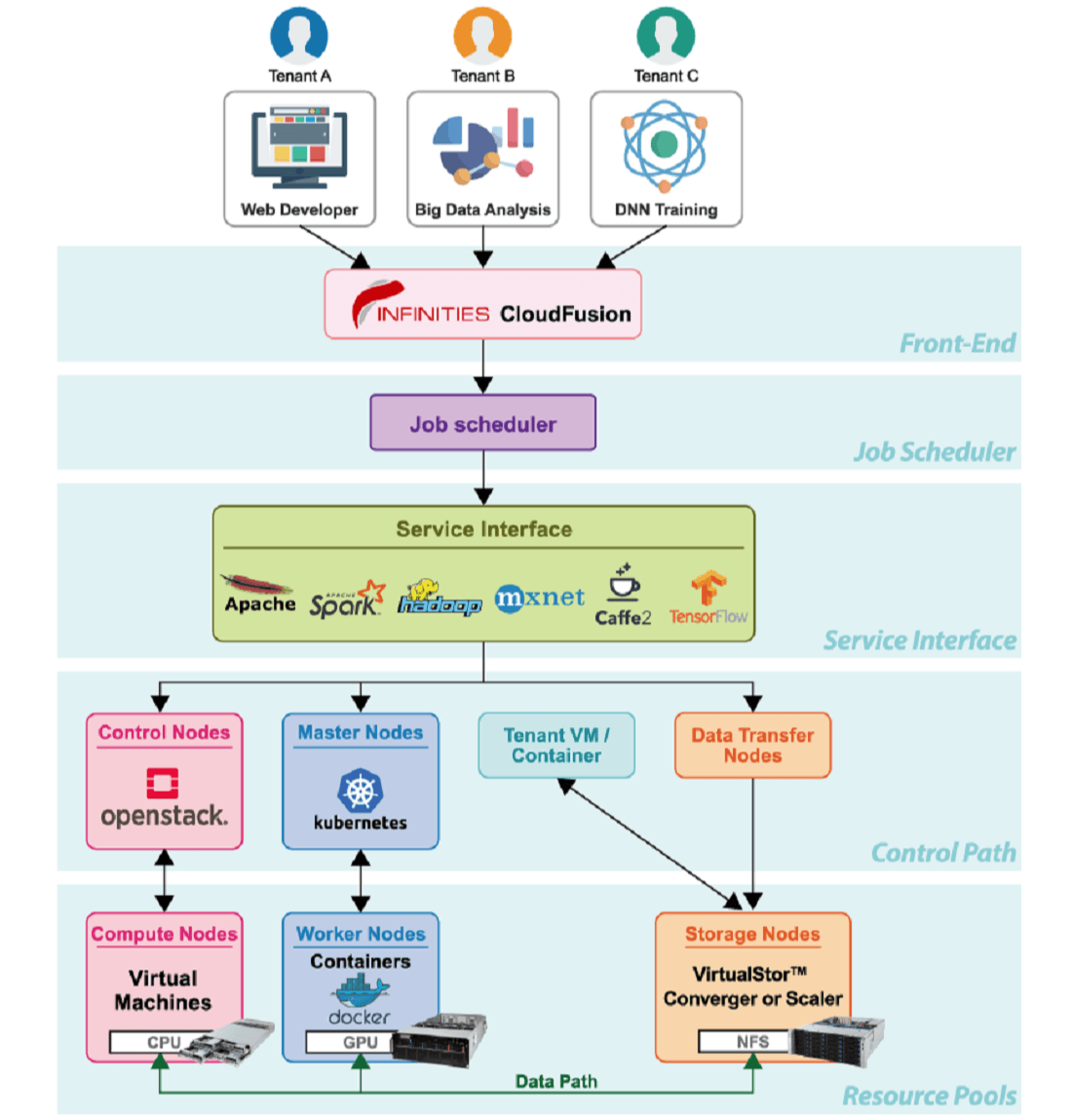
Together with InfinitiesSoft’s CloudFusion hybrid cloud management platform, it can integrate and manage more than 30 public and private cloud environments, including AWS, Alibaba Cloud, Microsoft Azure, Google Cloud, SoftLayer (IBM Cloud), VMware, XenServer, Hyper-V, OpenStack, and Kubernetes.
CloudFusion also provides flexible and open APIs that allow developers to extend the cloud ecosystem and support future expansion.
It can manage virtual machines across different time zones, service providers, and virtualization technologies while bringing cloud resources and commonly used management functions together through a unified interface.
This allows enterprises to focus more resources on their core business instead of spending significant time and effort managing different cloud platforms separately.
The Development of Deep Neural Networks
One of the most important technologies behind the latest wave of AI development is the Deep Neural Network (DNN).
Dr. Chih-Ke Chueh of the Information and Communications Research Laboratories at Taiwan’s Industrial Technology Research Institute (ITRI) explained the concept as follows:
Deep neural networks are a type of deep learning method within machine learning. They use mathematical models inspired by biological nervous systems to perform repeated calculations and training across multiple layers and architectures in order to identify an optimized and effective deep learning model.
Unlike traditional machine learning approaches that often require humans to define rules, DNNs can learn features automatically from training data by adjusting parameters within a designed neural network and gradually finding better results.
The key to developing effective DNN models is continuously providing high-quality data and performing repeated training.
Improving training quality therefore requires several elements.
First, organizations need large amounts of high-quality data and suitable neural network algorithms to improve model accuracy.
Second, they need to increase training speed.
This can be achieved through higher-performance computing platforms using technologies such as GPUs, while software optimization can further reduce the time required for each training cycle and decrease the total number of training iterations.
Improving AI Training Efficiency to Accelerate AI Adoption Across Industries
As more AI technologies are developed and introduced into commercial applications, the next stage is bringing AI into a wider range of industries.
Companies across different sectors can learn to use AI to analyze data, predict future trends, and improve operational efficiency and business value.
In other words, making DNN model development faster, easier, and more reliable can help more people adopt AI.
For this reason, ITRI developed a deep learning training platform that connects data, algorithms, and hardware.
The platform enables general users to quickly get started through an easy-to-use graphical interface. Users can manage projects and develop the DNN models they need without requiring extensive AI expertise.
The system can also automatically adjust parameters to accelerate model tuning and training. Users can analyze DNN models, training data, and debugging results to improve model accuracy.
The underlying training technology is equally important.
ITRI’s high-performance deep learning training system was demonstrated at the 2018 Open Compute Project Japan Workshop.
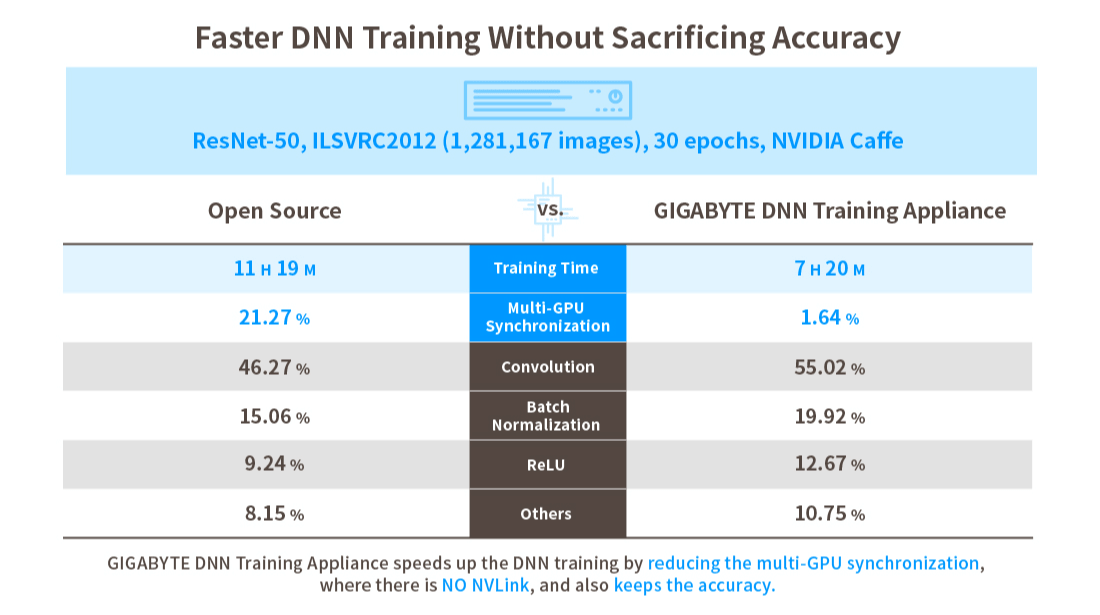
Using the same hardware configuration, the system reduced the amount of data synchronization required between multiple GPUs and delivered better image recognition performance and cost efficiency than existing open-source solutions.
GIGABYTE also worked with ITRI to develop the GIGABYTE DNN Training Appliance.
Based on the G481-HA1, the solution uses a computing topology optimized for AI training frameworks.
In addition to optimizing batch processing performance, it provides a graphical user interface that makes the system easier to operate.
In addition to optimizing batch processing performance, it provides a graphical user interface that makes the system easier to operate.
This allows users from different fields to start AI training projects without requiring dedicated software specialists.
Welcome to a World Where Tech Giants Hold More Data and Play a Growing Role in Enterprise IT
Developing a good AI prediction model is one challenge. Deploying and using that model effectively is another.
This brings us back to a fundamental question: what IT architecture should enterprises choose?
A common response today might be: “Why not simply move everything to the cloud?”
In reality, however, the situation is more complicated.
On March 12, 2019, Google and Gmail experienced major service outages.
On March 13, Gmail, Google Drive, and other Google services were affected by another outage.
Then, on March 14, Facebook experienced a major outage that also affected Instagram and WhatsApp, impacting users around the world.
Losing access to social media for several hours may be frustrating, but the consequences can be much more serious when enterprises rely entirely on external cloud services for critical business operations.
As more companies choose not to build and maintain their own IT infrastructure so they can focus on their core business, they become increasingly dependent on cloud service providers.
If a major cloud platform experiences a serious outage, the impact may extend far beyond consumer applications and directly affect business operations.
As large cloud technology companies continue to expand their presence in enterprise IT, organizations must therefore consider how to distribute risk and avoid excessive dependence on a single platform.
Open Source Is Not a Solution to Every Problem
Enterprises have several ways to reduce this risk.
They can build private clouds, use multiple public cloud providers, or combine both approaches.
These strategies can help businesses launch new services more quickly, but they also introduce additional management complexity.
A similar challenge can be seen in 5G edge computing environments, where deploying more edge servers creates a greater need for comprehensive server management solutions, such as management systems based on DMTF Redfish.
When an organization operates a large number of virtual machines or uses two or more different cloud platforms, the importance of cloud management and automation can easily be underestimated.
A unified management solution is therefore essential.
Over the years, the IT industry has adopted many open-source projects.
These include OpenStack, which has often been described as the Linux of the cloud era; Kubernetes, a container platform for automating the deployment, scaling, and operation of applications across clusters; and numerous software-defined storage solutions.
However, open source does not mean there are no costs.
More precisely, open source is not the same as free software.
More precisely, open source is not the same as free software.
Organizations still need the knowledge and expertise required to deploy, integrate, manage, and support these technologies.
In many cases, the companies that can provide reliable services around open-source software are large software vendors and technology companies with substantial engineering resources.
Not every organization has the expertise needed to manage these technologies effectively on its own.
Open-source operating systems and applications provide a high degree of flexibility, but many open-source projects are not centrally maintained by a single vendor or development team.
As a result, interoperability, compatibility, and integration between different components cannot always be guaranteed.
Organizations therefore still need system integrators with the experience required to validate individual open-source technologies and combine them into complete, reliable solutions.
Strong technical experience and proven customer deployments are essential. Without them, an infrastructure built from multiple technologies can become difficult to maintain and unstable over time.
Bringing AI, Cloud, Containers, and Software-Defined Storage Together
InfinitiesSoft and GIGABYTE jointly developed the CloudFusion hybrid cloud platform, which integrates public and private cloud environments.
The platform provides seamless integration between big data, cloud applications, multi-cloud workloads, and machine learning, supporting applications such as AI model training and big data analytics.
CloudFusion can virtualize a customer’s hardware infrastructure and turn it into a high-performance computing resource pool.
The platform can then dynamically allocate and deploy these resources according to workload requirements, allowing organizations to handle multiple workloads in a more flexible, efficient, and cost-effective way.
InfinitiesSoft CloudFusion also supports an integrated AI and data science cloud platform called AI-Stack.
AI-Stack combines OpenStack, Kubernetes, and Bigtera VirtualStor Scaler in a single platform.
It supports GPUs and AI workflow automation while reducing the complexity and learning curve associated with using TensorFlow, Caffe, and other deep learning tools.
Instead of spending significant time maintaining, configuring, and deploying infrastructure, users can focus on AI and machine learning tasks and deploy AI applications more quickly.
Bigtera VirtualStor Scaler can also provide significantly higher read and write performance and greater usable storage capacity than conventional open-source software-defined storage solutions.
Combined with the CloudFusion hybrid cloud management platform, GIGABYTE servers support more than ten cloud platforms while providing a single management interface, consistent functionality, and simplified deployment.
Combined with the CloudFusion hybrid cloud management platform, GIGABYTE servers support more than ten cloud platforms while providing a single management interface, consistent functionality, and simplified deployment.
Whether an enterprise uses a hybrid cloud or multiple heterogeneous cloud environments, these resources can be integrated into a unified platform for centralized management.
From virtual machines used as compute nodes to capacity-focused worker nodes and software-defined storage, GIGABYTE offers server solutions designed and manufactured in Taiwan for a wide range of infrastructure requirements.
References:
Mark Harris, Chief Technologist, GPU Computing, UNC Ph.D. (2003). A Brief History of GPGPU.
Hisa Ando (2017). GPUを支える技術 ――超並列ハードウェアの快進撃 [技術基礎].