Hardwareluxx has spent more than two decades telling several million German-speaking readers which hardware is worth buying. In 2025, the publication turned that judgment on itself. Its own production environment had been running for close to five years on ESX virtualization and SATA storage, and in the meantime its traffic had quadrupled while AI-driven workloads piled on top. The rebuild that followed got a name, "Project PMXX", and a foundation: GIGABYTE's R284-S93-AAL1, a 2U dual-socket rack server built for Intel Xeon 6. Twelve NVMe drives later, the system was reading in excess of 113 GB/s, running the publication's live environment on Proxmox VE, and earning Hardwareluxx's "Business Hero Award".
A Publication Outgrows Its Own Server Room
There is a particular discomfort in running infrastructure you would not recommend to your readers. Hardwareluxx, a leading German technology media platform and member of the European Nimbus Alliance, had reached exactly that point. The platform that had served it well for years was no longer sized for what the audience had become. The storage layer signaled a clear need to rebuild.
Two problems had to be solved at once. The first was the hypervisor. Consolidating onto Proxmox VE promised more efficient resource allocation and simpler management across a single platform, and the team committed to it. The second was older and entirely architectural: no amount of new compute was going to help with a SATA-based storage tier underneath, setting the ceiling the system kept hitting. Migrating the hypervisor without solving the underlying storage issue would have produced a more modern environment with precisely the same bottleneck.
So, the requirements were written from the bottleneck backward. Enough cores and enough memory bandwidth to host a dense virtual machine estate. Local NVMe storage fast enough to make the old tier a thing of the past. And real expansion capacity left over afterwards, because a publication that covers AI infrastructure would like to be able to run some.
Where the Lanes Actually Go
Anyone who has specified a dense NVMe server knows the trap in the spec sheet. Twelve bays are advertised, twelve fast drives go in, and the finished array delivers nowhere near twelve drives' worth of throughput. The drives are almost never the reason. The lanes are. On many platforms the links feeding the front bays are shared or stepped down, so a bay sold as NVMe-capable is quietly taking turns for bandwidth it does not own.
The R284-S93-AAL1 does not do this, and Hardwareluxx checked. GIGABYTE dedicates three PCIe Gen5 x16 links to the front backplane so that every one of the twelve bays runs at its full Gen5 x4 allocation, with the internal and rear connections handled the same way. In the team's own testing, the performance limit in software RAID configurations turned out not to be the drives or their links at all, but the UPI interconnect between the two processors. When the bottleneck you find is the CPU-to-CPU bus, the storage subsystem has done its job.
The platform is generous in other directions, too. It is a long 2U at 815mm, which is what buys room for both a dense storage front end and full-height GPUs behind it. Thirty-two DDR5 DIMM slots support RDIMMs to 6400 MT/s and MRDIMMs to 8000 MT/s. Four PCIe Gen5 x16 slots and two OCP NIC 3.0 slots handle expansion, with 12VHPWR connectors on both power supplies for high-draw accelerators.
The R284-S93-AAL1 does not do this, and Hardwareluxx checked. GIGABYTE dedicates three PCIe Gen5 x16 links to the front backplane so that every one of the twelve bays runs at its full Gen5 x4 allocation, with the internal and rear connections handled the same way. In the team's own testing, the performance limit in software RAID configurations turned out not to be the drives or their links at all, but the UPI interconnect between the two processors. When the bottleneck you find is the CPU-to-CPU bus, the storage subsystem has done its job.
The platform is generous in other directions, too. It is a long 2U at 815mm, which is what buys room for both a dense storage front end and full-height GPUs behind it. Thirty-two DDR5 DIMM slots support RDIMMs to 6400 MT/s and MRDIMMs to 8000 MT/s. Four PCIe Gen5 x16 slots and two OCP NIC 3.0 slots handle expansion, with 12VHPWR connectors on both power supplies for high-draw accelerators.
The Build
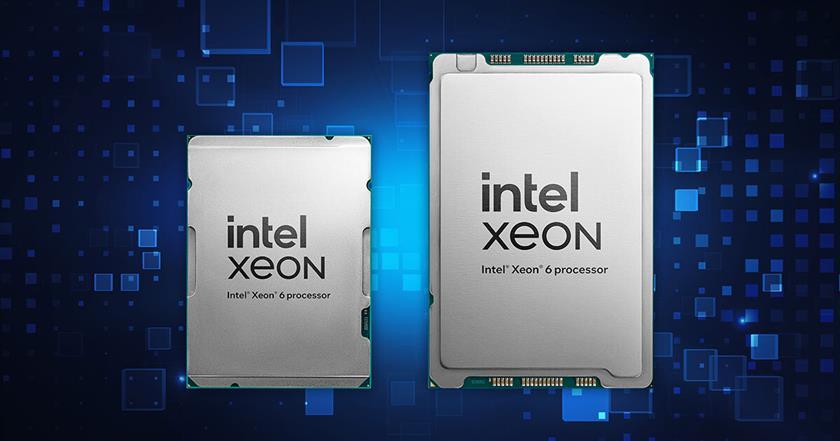
Hardwareluxx specified two Intel Xeon 6737P processors, Granite Rapids parts at 32 cores apiece for 64 cores and 128 threads in total, running up to 4.2 GHz within a 270W envelope that sits comfortably under the platform's 300W per-socket allowance. Memory came from Kingston: 16 Server Premier DDR5 64GB RDIMMs for 1TB total, deliberately one module per channel so that each processor gets its full eight-channel interface. Measured bandwidth came in just under 500 GB/s.
The front bays took twelve Kingston DC3000ME PCIe Gen5 NVMe U.2 SSDs. Proxmox itself lives on two internal M.2 slots, where the team took an unglamorous and sensible shortcut, using inexpensive 1TB desktop-class Gen5 drives in a ZFS RAID1 pair rather than spending enterprise money on a boot mirror. An NVIDIA RTX A1000 occupies one expansion slot, not for graphics but to run GRAID Technology's SupremeRAID Pro, which moves RAID parity calculation off the host entirely. That matters in a virtualization host: every write into a parity array demands arithmetic, and in software that arithmetic is paid for with CPU cycles the virtual machines were supposed to get. Networking comes from an Intel two-port 10GbE card and a QNAP two-port 100GbE adapter.
Across all twelve drives in RAID 0, the array read in excess of 113 GB/s. With parity in the path, RAID 5 held around 105 GB/s.
The front bays took twelve Kingston DC3000ME PCIe Gen5 NVMe U.2 SSDs. Proxmox itself lives on two internal M.2 slots, where the team took an unglamorous and sensible shortcut, using inexpensive 1TB desktop-class Gen5 drives in a ZFS RAID1 pair rather than spending enterprise money on a boot mirror. An NVIDIA RTX A1000 occupies one expansion slot, not for graphics but to run GRAID Technology's SupremeRAID Pro, which moves RAID parity calculation off the host entirely. That matters in a virtualization host: every write into a parity array demands arithmetic, and in software that arithmetic is paid for with CPU cycles the virtual machines were supposed to get. Networking comes from an Intel two-port 10GbE card and a QNAP two-port 100GbE adapter.
Across all twelve drives in RAID 0, the array read in excess of 113 GB/s. With parity in the path, RAID 5 held around 105 GB/s.
What It Does in Production
Records are enjoyable, but Hardwareluxx had a publication to keep online. The live configuration favors availability and predictable latency: an eight-drive GPU-accelerated RAID6 array on Proxmox VE 9.1, with two drives in software RAID1 and two held as hot spares. In that state it delivers 80.2 GB/s sequential read, 26.6 GB/s sequential write, roughly 7.42 million random 4K read IOPS, and roughly 1.31 million random 4K write IOPS. Enough headroom that database queries, transactional I/O, and a dense VM estate can run simultaneously without contending for attention.
The supporting cast held up too. With everything installed, the server idled at 374.7W and drew 438.2W with an active drive group, and the team rarely pushed it past 800W even during storage and memory benchmarking. The redundant 2700W 80 PLUS Titanium supplies hit 90% efficiency at only 10% load, which places this build squarely in their best operating band rather than oversizing it into waste. Four hot-swap high-performance fans keep the thermals uneventful. And the ASPEED AST2600 BMC handled remote power control, hardware monitoring, KVM, OS installation over virtual media, and firmware updates, all of which Hardwareluxx confirmed working, and all of which translate directly into fewer remote-hands invoices.
The supporting cast held up too. With everything installed, the server idled at 374.7W and drew 438.2W with an active drive group, and the team rarely pushed it past 800W even during storage and memory benchmarking. The redundant 2700W 80 PLUS Titanium supplies hit 90% efficiency at only 10% load, which places this build squarely in their best operating band rather than oversizing it into waste. Four hot-swap high-performance fans keep the thermals uneventful. And the ASPEED AST2600 BMC handled remote power control, hardware monitoring, KVM, OS installation over virtual media, and firmware updates, all of which Hardwareluxx confirmed working, and all of which translate directly into fewer remote-hands invoices.
"For Project PMXX, we needed a platform that could combine high-performance virtualization, extremely fast local NVMe storage and high-speed networking without limiting future expansion. The GIGABYTE R284-S93-AAL1 gave us exactly that flexibility, while allowing us to fully utilize PCIe Gen5 across the system," says Dennis Bode, editor in chief of Hardwareluxx.
Business Hero
Hardwareluxx awarded the R284-S93-AAL1 its "Business Hero Award", citing its orientation toward high-performance computing, its thorough implementation of the Intel Granite Rapids platform, its cooling design, its GPU expandability, its performance, its efficiency and power headroom, and its management functions. The team also noted, fairly, that a server built for twelve front bays is not the right choice for anyone chasing maximum storage density, and that they would configure the networking differently next time.
Thank you for reading our insight on how Hardwareluxx rebuilt its own infrastructure around GIGABYTE's R284-S93-AAL1. For consultation on how GIGABYTE rack servers can anchor your own virtualization or storage refresh, we welcome you to reach out to us.
That is what a review from people who then have to live inside the product looks like, and it is worth more than a clean sweep. Project PMXX makes a point that generalizes well beyond one publication's server room: modernization rarely turns on a single faster component. It turns on a platform that refuses to bottleneck itself, where lanes are not shared, memory channels are not left half empty, and the expansion budget has not already been spent on the day the system ships. Whether the workload is Proxmox or VMware virtualization, software-defined storage, database acceleration, or AI inference, that principle holds.
Thank you for reading our insight on how Hardwareluxx rebuilt its own infrastructure around GIGABYTE's R284-S93-AAL1. For consultation on how GIGABYTE rack servers can anchor your own virtualization or storage refresh, we welcome you to reach out to us.