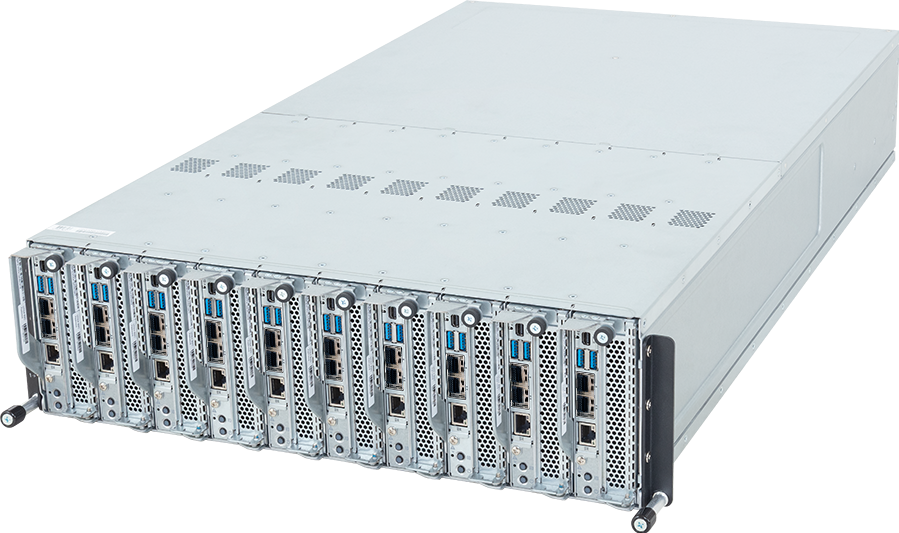
Blade Server

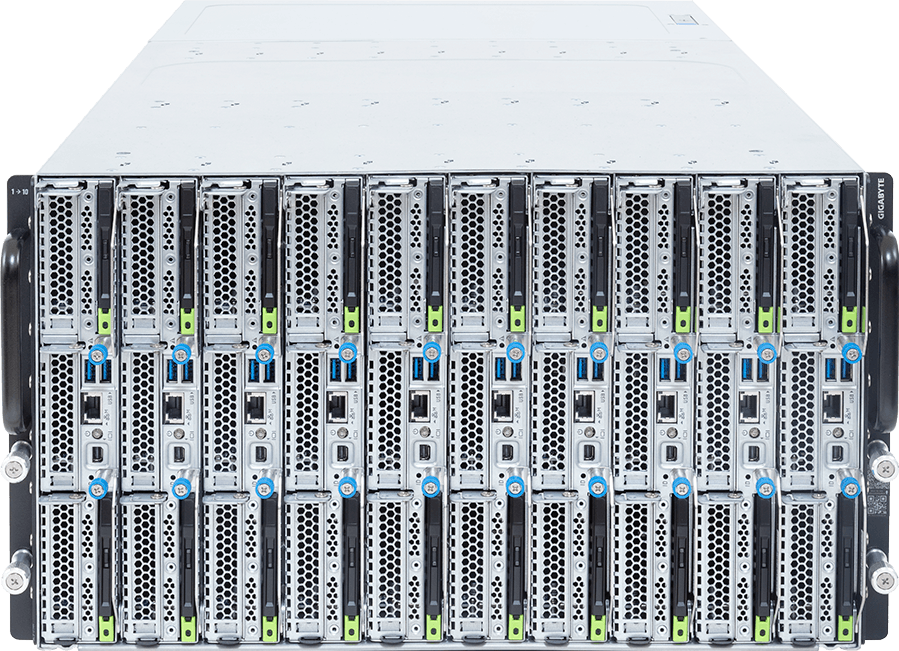
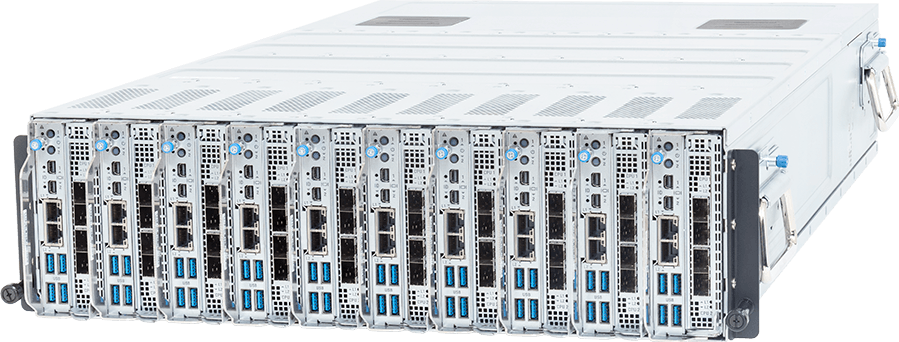
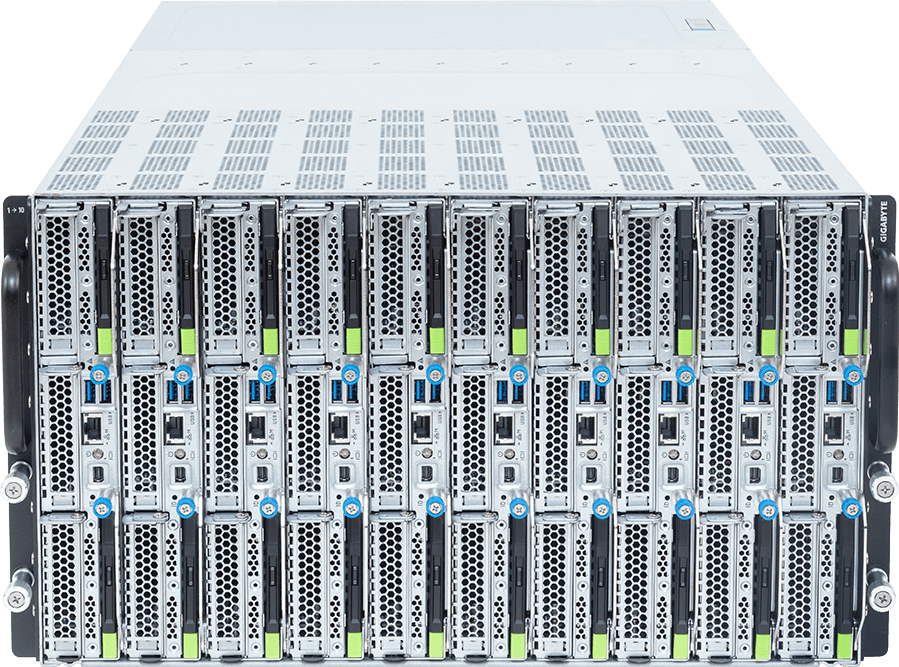
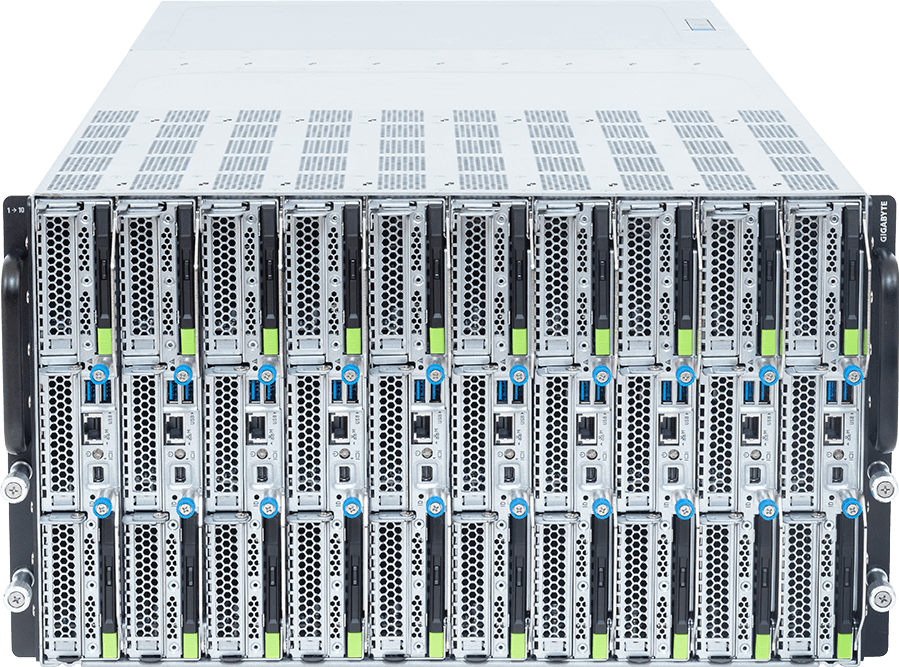
Blade servers are designed for maximum space efficiency, featuring a high-density, resource-sharing architecture with hot-swappable modules. Scalable for both network core and edge deployments, they deliver efficient, powerful, and cost-effective performance.

Applications Include :

  • Edge Data Center
  • Enterprise-scale Virtualization
  • GPUaaS
  • AI Cloud
GIGABYTE Blade Server
Filter
Platform
Cooling Type
Processor Vendor
CPU Series
CPU Type
CPUs
Form Factor
GPUs
LAN Speed
LAN Ports
DIMM Slots
Drive Bays
CPU Power
Application

B685

6U DP Blade (1)
Copy Series Link
6U DP Blade High-Density-Server B685
  • CPU Type
  • DIMM Slots
  • LAN Speed
  • LAN Ports
  • Drive Bays
  • PSU
  • Cooling Type
  • AMD EPYC 9006 SP7
  • 32
  • --
  • 0
  • 20 x E3.S
  • 12 x 3200 W

B353

3U UP Blade (1)
Copy Series Link
3U UP Blade High-Density-Server B353
  • CPU Type
  • DIMM Slots
  • LAN Speed
  • LAN Ports
  • Drive Bays
  • PSU
  • Cooling Type
  • AMD Ryzen 9000
  • AMD EPYC 4005
  • 4
  • 25 Gb/s + 1 Gb/s
  • 3
  • --
  • Quad 3200 W

B683

6U DP Blade (1)
Copy Series Link
6U DP Blade High-Density-Server B683
  • CPU Type
  • DIMM Slots
  • LAN Speed
  • LAN Ports
  • Drive Bays
  • PSU
  • Cooling Type
  • AMD EPYC 9004
  • AMD EPYC 9005
  • 24
  • --
  • 0
  • 20 x E3.S
  • 10 x 3200 W

B684

6U DP Blade (1)
Copy Series Link
6U DP Blade High-Density-Server B684
  • CPU Type
  • DIMM Slots
  • LAN Speed
  • LAN Ports
  • Drive Bays
  • PSU
  • Cooling Type
  • Intel Xeon 6900 Series
  • Intel Xeon 6900E+
  • 24
  • --
  • 0
  • 20 x E3.S
  • 10 x 3200 W

B343

3U UP Blade (2)
Copy Series Link
3U UP Blade High-Density-Server B343
  • CPU Type
  • DIMM Slots
  • LAN Speed
  • LAN Ports
  • Drive Bays
  • PSU
  • Cooling Type
  • AMD Ryzen 9000
  • AMD EPYC 4005
  • 4
  • 25 Gb/s
  • 2
  • 20 x 2.5"
  • Quad 2000 W
  • Intel Xeon E-2400
  • Intel Xeon 6300 Series
  • 4
  • 1 Gb/s
  • 2
  • 20 x 2.5"
  • Dual 3200 W

Blade Server FAQ

What is a blade server used for?

Blade servers are commonly used in data centers and large IT environments where a large amount of compute must be deployed within limited rack space. Each blade server is a compact server module that installs into a shared blade chassis, making the design well suited to high-density workloads such as virtualization, cloud and web hosting, large-scale enterprise applications, and high-performance computing.
A rack server is a standalone system installed directly in a standard rack, with its own power supplies, cooling, network ports, and management controller. A blade server is a modular server that operates inside a blade chassis, which provides redundant power and cooling, networking through integrated switch or pass-through modules, and centralized management across all installed blades. A blade server therefore achieves higher deployment density, while a rack server offers more expansion capacity per system, such as PCIe slots and drive bays.
The primary advantage is deployment density. Multiple blade servers install into a single chassis, fitting more servers into the same rack space than an equivalent number of standalone systems. Sharing power supplies, fans, and network modules at the chassis level reduces the power and cooling overhead of the system as a whole and significantly reduces cabling. Blades, power supplies, fans, and switch modules are hot-swappable, so failed units can be replaced without taking the chassis offline, and new blades can be added to a pre-cabled chassis with minimal setup, shortening both deployment and maintenance time.