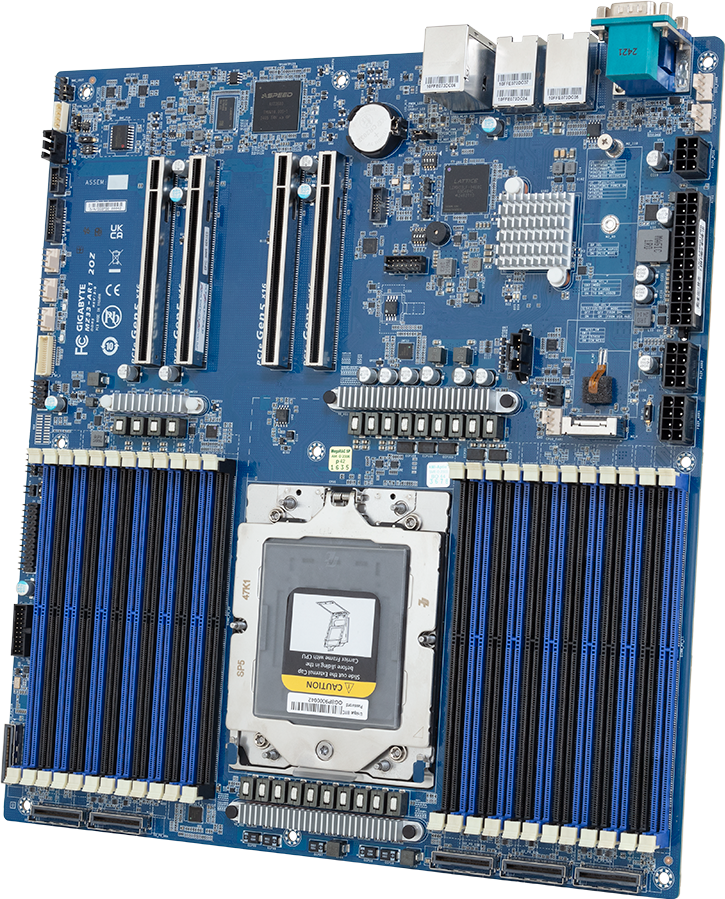
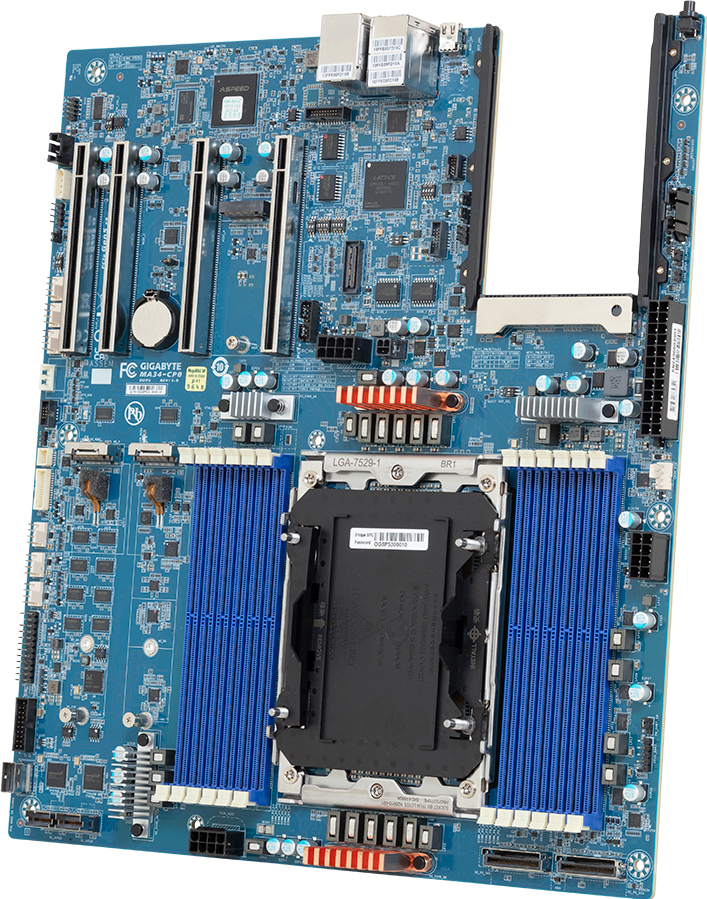
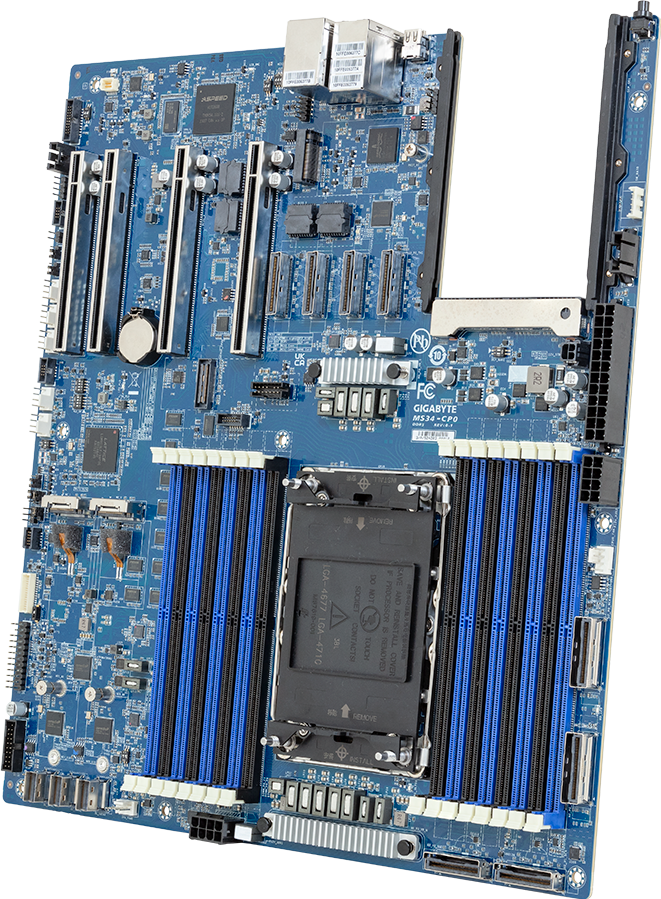
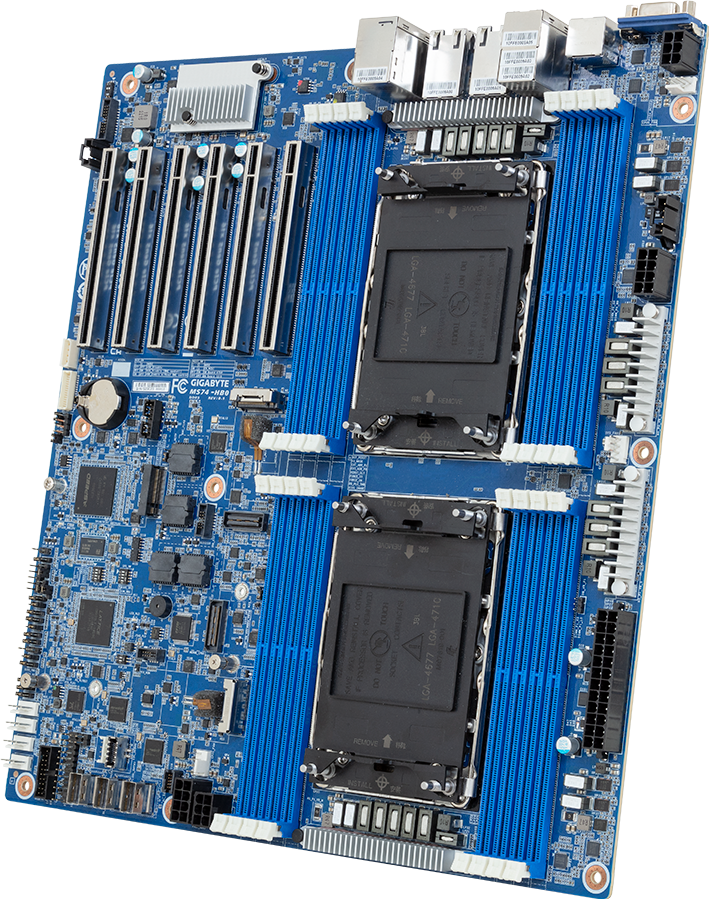
Server Motherboard

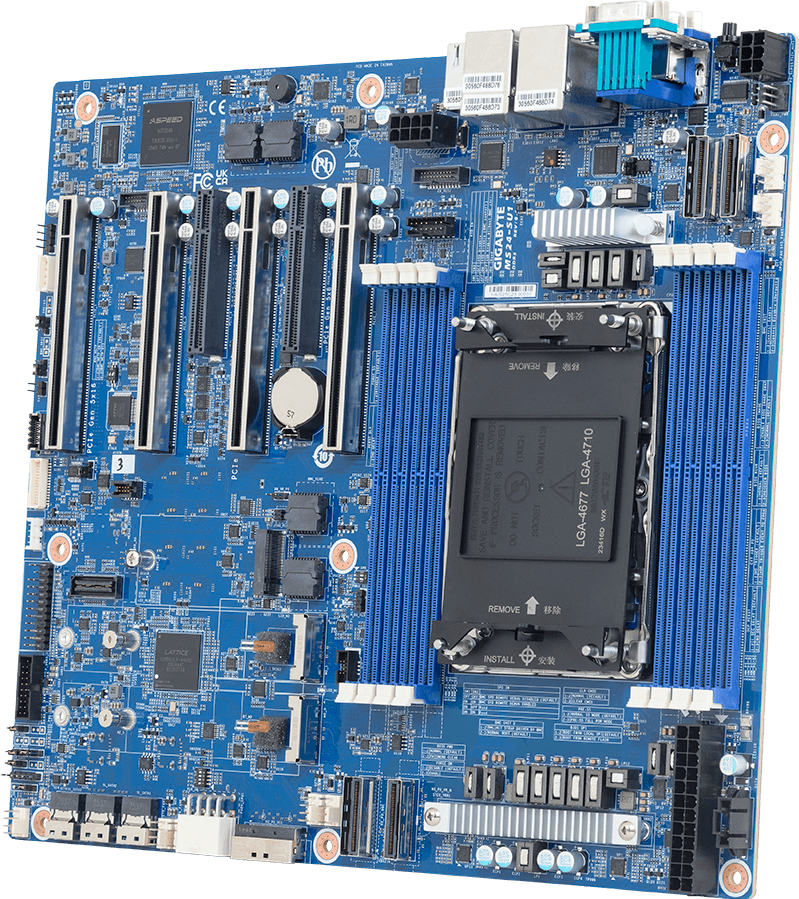
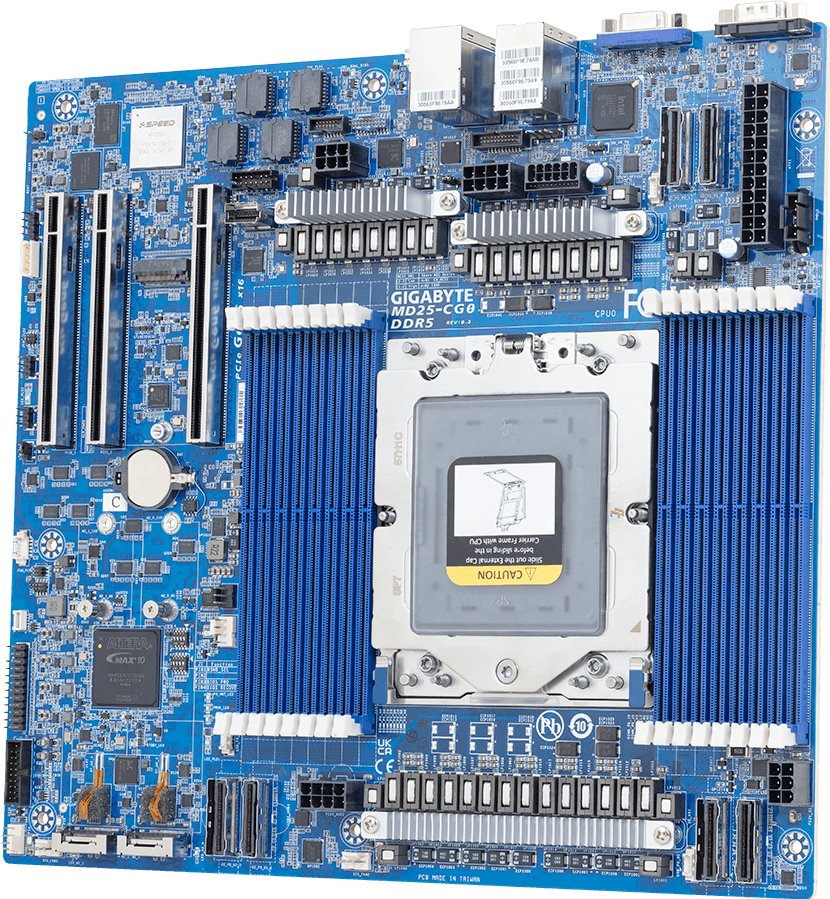
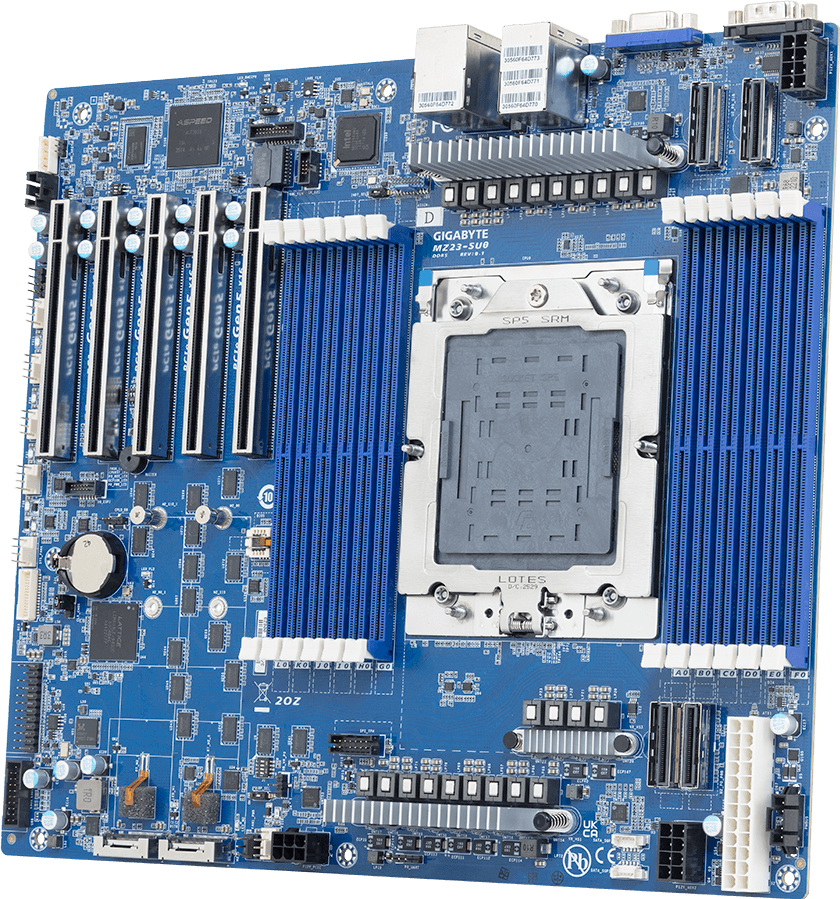
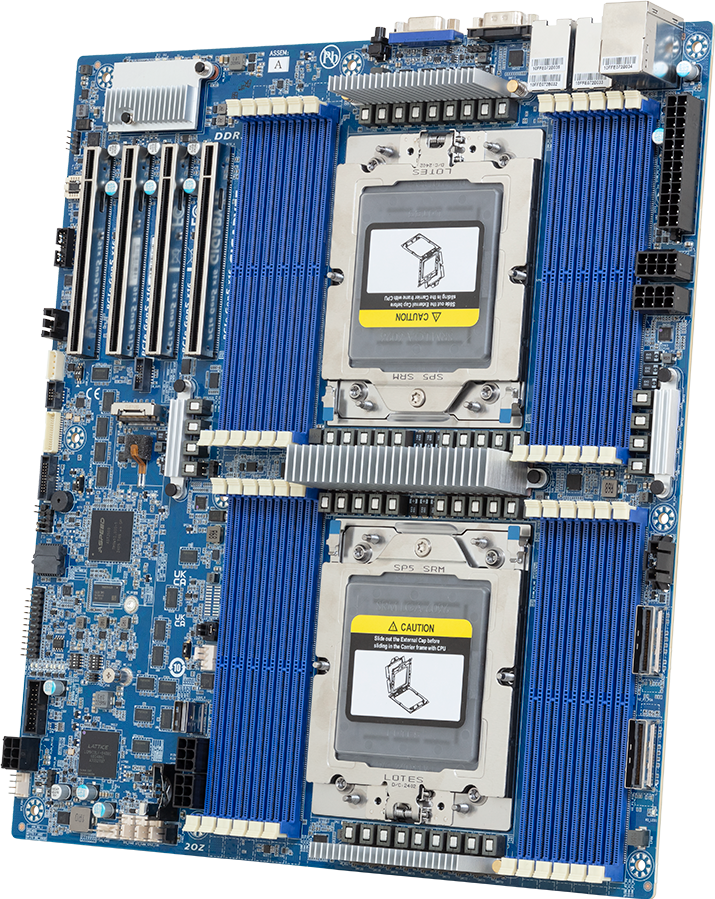
Enterprise-grade server motherboards are designed for reliability, security, manageability, and scalability. Key features include out-of-band management, ECC memory support, compatibility with server OS, and high core count CPU support. Available in single or dual socket options for x86 processors from AMD and Intel. Select models also support the ARM-based Ampere Computing platform for alternative performance and power efficiency.

Applications Include :

  • 3D Design & Creation
  • Demanding Applications
  • High Performance Computing (HPC)
  • Standard Web/Database/Storage Servers
  • Video Processing & Rendering
GIGABYTE Server Motherboard
Filtre
Processor Vendor
CPU
Chipset
Form Factor
LAN Speed
LAN Ports
Number of DIMM Slots

MZ23

(1)
Copy Series Link
Server-Motherboard MZ23
  • Processor Vendor
  • CPU Type
  • Chipset
  • Form Factor
  • LAN Speed
  • LAN Ports
  • DIMM Slots
  • AMD
  • AMD EPYC 9004
  • AMD EPYC 9005
  • AMD® SoC
  • CEB
  • 1 Gb/s
  • 2
  • 12

MZ73

(3)
Copy Series Link
Server-Motherboard MZ73
  • Processor Vendor
  • CPU Type
  • Chipset
  • Form Factor
  • LAN Speed
  • LAN Ports
  • DIMM Slots

Quick Shipping

  • AMD
  • AMD EPYC 9004
  • AMD EPYC 9005
  • AMD® SoC
  • E-ATX
  • 10 Gb/s
  • 2
  • 24

Quick Shipping

  • AMD
  • AMD EPYC 9004
  • AMD EPYC 9005
  • AMD® SoC
  • E-ATX
  • 10 Gb/s
  • 2
  • 24

Quick Shipping

  • AMD
  • AMD EPYC 9004
  • AMD EPYC 9005
  • AMD® SoC
  • E-ATX
  • 10 Gb/s
  • 2
  • 24

MZ33

(2)
Copy Series Link
Server-Motherboard MZ33
  • Processor Vendor
  • CPU Type
  • Chipset
  • Form Factor
  • LAN Speed
  • LAN Ports
  • DIMM Slots

Quick Shipping

  • AMD
  • AMD EPYC 9004
  • AMD EPYC 9005
  • AMD® SoC
  • E-ATX
  • 10 Gb/s
  • 2
  • 24
  • AMD
  • AMD EPYC 9004
  • AMD EPYC 9005
  • AMD® SoC
  • E-ATX
  • 1 Gb/s
  • 2
  • 12

MA34

(1)
Copy Series Link
Server-Motherboard MA34
  • Processor Vendor
  • CPU Type
  • Chipset
  • Form Factor
  • LAN Speed
  • LAN Ports
  • DIMM Slots
  • Intel
  • Intel Xeon 6900 Series
  • Intel Xeon 6900E+
  • Intel® SoC
  • E-ATX
  • 1 Gb/s
  • 2
  • 12

MS34

(1)
Copy Series Link
Server-Motherboard MS34
  • Processor Vendor
  • CPU Type
  • Chipset
  • Form Factor
  • LAN Speed
  • LAN Ports
  • DIMM Slots
  • Intel
  • Intel Xeon 6700/6500 Series
  • Intel Xeon 6700/6500 Series R1S
  • Intel® SoC
  • E-ATX
  • 1 Gb/s
  • 2
  • 16

MS74

(1)
Copy Series Link
Server-Motherboard MS74
  • Processor Vendor
  • CPU Type
  • Chipset
  • Form Factor
  • LAN Speed
  • LAN Ports
  • DIMM Slots
  • Intel
  • Intel Xeon 6700/6500 Series
  • Intel® SoC
  • E-ATX
  • 10 Gb/s + 1 Gb/s
  • 4
  • 16

MS04

(1)
Copy Series Link
Server-Motherboard MS04
  • Processor Vendor
  • CPU Type
  • Chipset
  • Form Factor
  • LAN Speed
  • LAN Ports
  • DIMM Slots
  • Intel
  • Intel Xeon 6700/6500 Series
  • Intel® SoC
  • ATX
  • 1 Gb/s
  • 2
  • 8

MS33

(3)
Copy Series Link
Server-Motherboard MS33
  • Processor Vendor
  • CPU Type
  • Chipset
  • Form Factor
  • LAN Speed
  • LAN Ports
  • DIMM Slots
  • Intel
  • 4th Gen Intel Xeon Scalable
  • Intel Xeon CPU Max Series
  • 5th Gen Intel Xeon Scalable
  • Intel® C741
  • E-ATX
  • 1 Gb/s
  • 2
  • 16
  • Intel
  • 4th Gen Intel Xeon Scalable
  • Intel Xeon CPU Max Series
  • 5th Gen Intel Xeon Scalable
  • Intel® C741
  • E-ATX
  • 10 Gb/s
  • 2
  • 16
  • Intel
  • 4th Gen Intel Xeon Scalable
  • Intel Xeon CPU Max Series
  • 5th Gen Intel Xeon Scalable
  • Intel® C741
  • E-ATX
  • 10 Gb/s
  • 2
  • 16

Server Motherboard FAQ

What is a server motherboard?

A server motherboard is the main circuit board of a server, designed for enterprise workloads and continuous operation. It connects and manages key components including the CPU, memory, storage, networking, and expansion cards.
The fundamental difference comes down to purpose and design priority. Consumer motherboards are optimized for single-user performance, gaming features, and cost efficiency. Server motherboards, by contrast, are built for stability under sustained enterprise workloads, typically supporting multiple CPU sockets, ECC memory, more RAM slots, and redundant components. Remote management capability via a dedicated BMC chip is also standard on server boards and generally absent on consumer ones.
When choosing a server motherboard, start with the CPU platform, since the board must support your processor. Intel Xeon and AMD EPYC are the most common in enterprise environments. From there, consider how many CPU sockets you need, how much RAM the workload requires and how many DIMM slots the board provides, and how many PCIe slots are available. Form factor matters as well, since the board must physically fit the chassis.
E-ATX, ATX, and Mini-ITX are motherboard form factors that differ primarily in size and expansion capability. E-ATX (Extended ATX) is the largest of the three, offering the most space for components such as additional RAM slots and PCIe expansion slots, making it suitable for high-end workstations and servers. ATX is the standard mainstream size, balancing expansion options with broad case compatibility. Mini-ITX is much smaller, designed for compact builds, and typically offers fewer expansion slots and limited upgrade options.