Storage Server

Designed for enterprise and data center environments, these servers offer capacity, reliability, and flexibility. They provide fast read/write speeds with flash drives, as well as enterprise-grade SATA and SAS drives in 2.5" and 3.5" form factors. Built-in scalability meets the demands of data-intensive workloads.

Applications Include :

  • Software-defined Storage (SDS)
  • Big Data
  • Cloud Hosting Workloads
  • Backup Server
  • Multimedia Server
GIGABYTE Storage Server
Filtre
Platform
Cooling Type
Processor Vendor
CPU Series
CPU Type
CPUs
Form Factor
GPU Type
GPUs
LAN Speed
LAN Ports
DIMM Slots
Drive Bays
Certifications
CXL memory expansion
SupremeRAID
CPU Power
Application

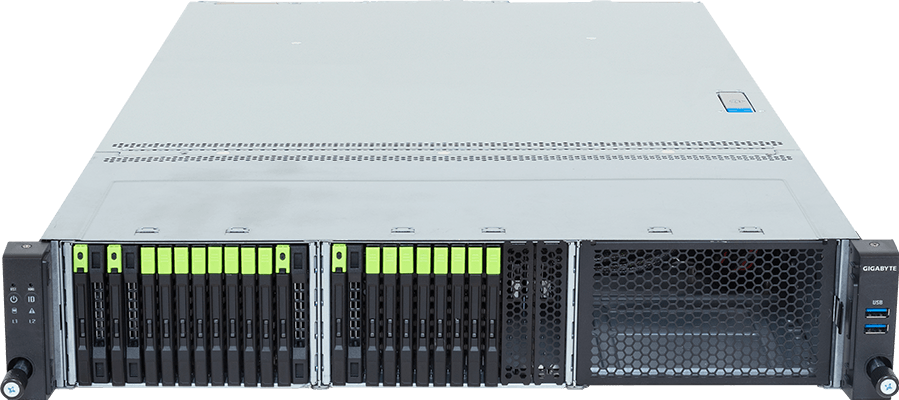
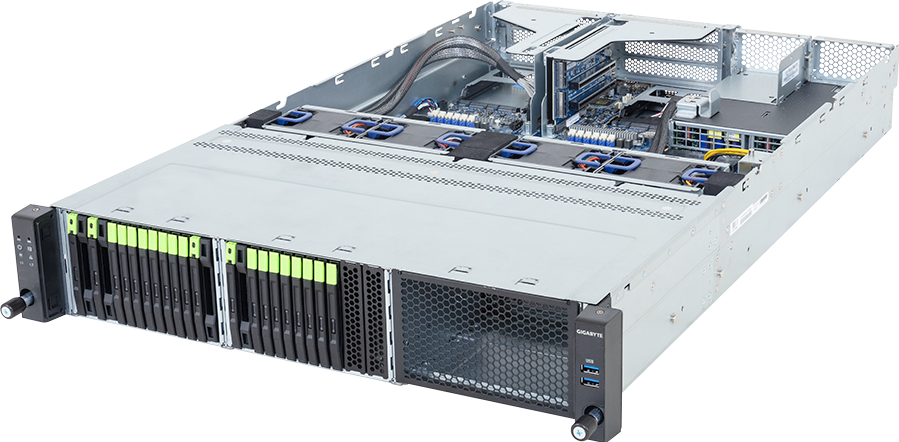
R265

2U UP General Purpose (3)
Copy Series Link
2U UP General Purpose Rack-Server R265
  • CPU Type
  • DIMM Slots
  • LAN Speed
  • LAN Ports
  • Drive Bays
  • PSU
  • Cooling Type
  • AMD EPYC 9006 SP8
  • 16
  • 1 Gb/s
  • 2
  • 16 x E3.S
  • Dual 1600 W
  • AMD EPYC 9006 SP8
  • 16
  • 1 Gb/s
  • 2
  • 24 x 2.5"
  • Dual 1600 W
  • AMD EPYC 9006 SP7
  • 16
  • 1 Gb/s
  • 2
  • 20 x E3.S
  • Dual 3200 W

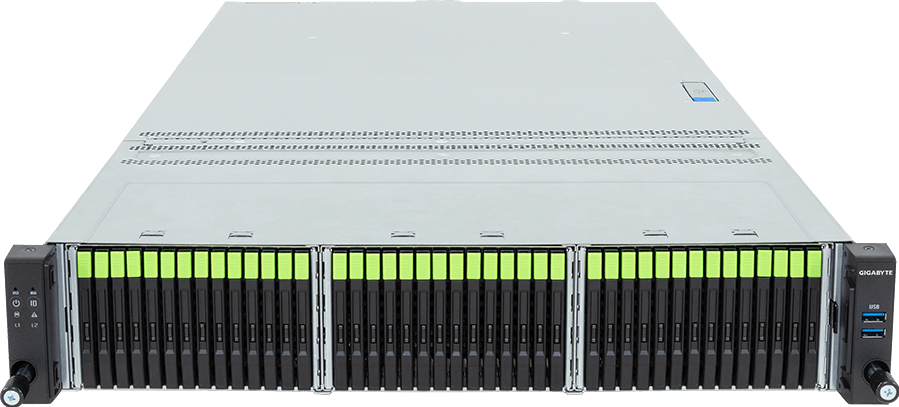
R285

2U DP General Purpose (2)
Copy Series Link
2U DP General Purpose Rack-Server R285
  • CPU Type
  • DIMM Slots
  • LAN Speed
  • LAN Ports
  • Drive Bays
  • PSU
  • Cooling Type
  • AMD EPYC 9006 SP8
  • 32
  • --
  • 0
  • 40 x E3.S
  • Dual 3200 W
  • AMD EPYC 9006 SP8
  • 32
  • --
  • 0
  • 24 x 2.5"
  • Dual 3200 W

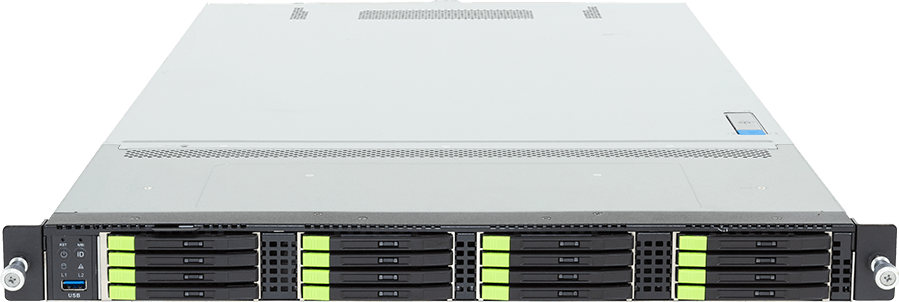
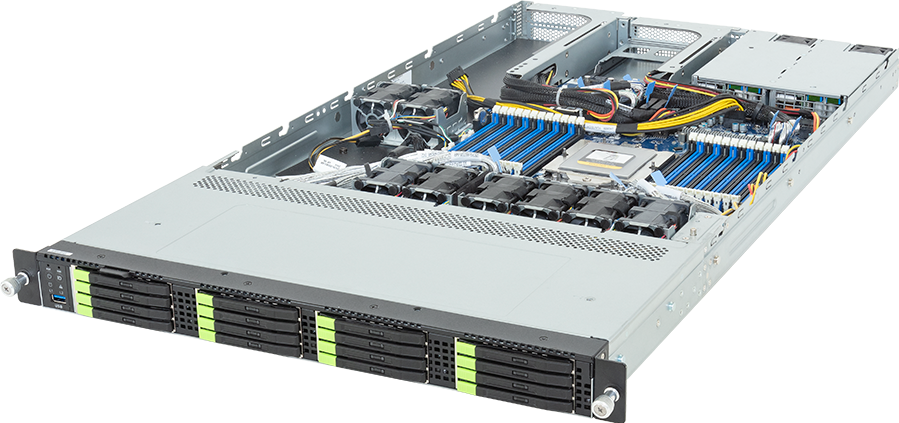
R165

1U UP General Purpose (1)
Copy Series Link
1U UP General Purpose Rack-Server R165
  • CPU Type
  • DIMM Slots
  • LAN Speed
  • LAN Ports
  • Drive Bays
  • PSU
  • Cooling Type
  • AMD EPYC 9006 SP8
  • 16
  • 1 Gb/s
  • 2
  • 16 x E3.S
  • Dual 2000 W

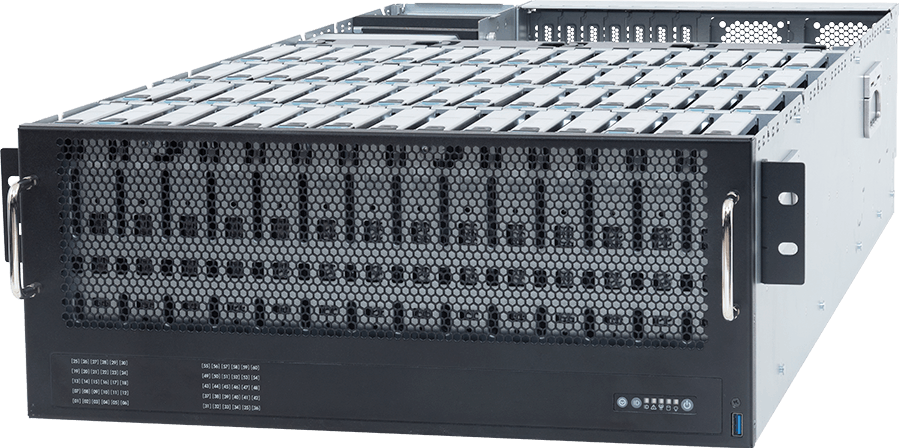
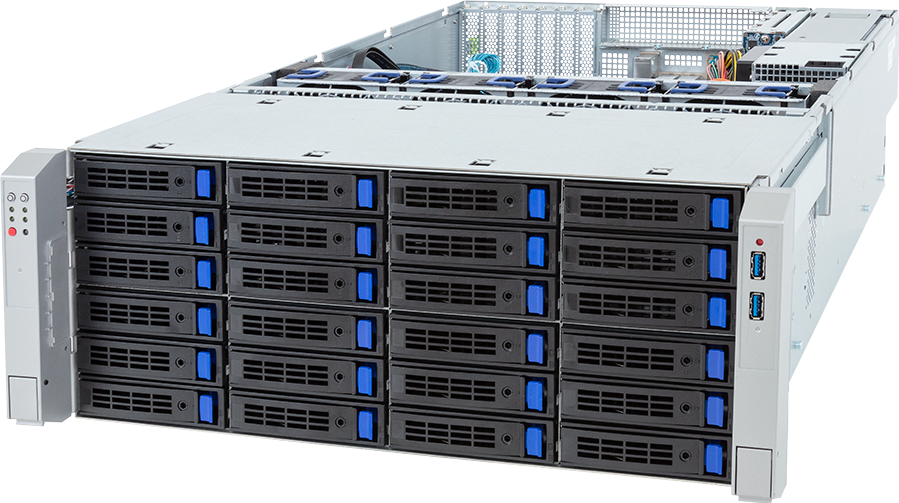
S463

4U Storage Maximized (1)
Copy Series Link
4U Storage Maximized Storage-Server S463
  • CPU Type
  • DIMM Slots
  • LAN Speed
  • LAN Ports
  • Drive Bays
  • PSU
  • Cooling Type
  • AMD EPYC 9004
  • AMD EPYC 9005
  • 24
  • 10 Gb/s
  • 2
  • 60 x 3.5" + 8 x 2.5"
  • Quad 800 W

S453

4U UP Storage Maximized (2)
Copy Series Link
4U UP Storage Maximized Storage-Server S453
  • CPU Type
  • DIMM Slots
  • LAN Speed
  • LAN Ports
  • Drive Bays
  • PSU
  • Cooling Type
  • AMD EPYC 9004
  • AMD EPYC 9005
  • 24
  • 10 Gb/s
  • 2
  • 36 x 3.5"/2.5" + 2 x 2.5"
  • Dual 1600 W
  • 4th Gen Intel Xeon Scalable
  • 5th Gen Intel Xeon Scalable
  • 16
  • 10 Gb/s + 1 Gb/s
  • 4
  • 36 x 3.5"/2.5" + 2 x 2.5"
  • Dual 1600 W

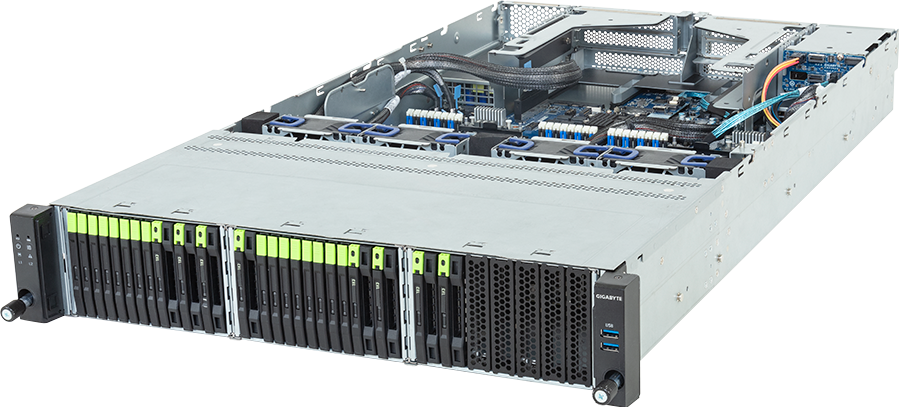
R263

2U UP General Purpose (3)
Copy Series Link
2U UP General Purpose Rack-Server R263
  • CPU Type
  • DIMM Slots
  • LAN Speed
  • LAN Ports
  • Drive Bays
  • PSU
  • Cooling Type
  • AMD EPYC 9004
  • AMD EPYC 9005
  • 12
  • 1 Gb/s
  • 1
  • 16 x E3.S
  • Dual 2000 W
  • AMD EPYC 9004
  • AMD EPYC 9005
  • 24
  • --
  • 0
  • 16 x E3.S
  • Dual 2700 W
  • AMD EPYC 9004
  • AMD EPYC 9005
  • 24
  • --
  • 0
  • 24 x 2.5"
  • Dual 2000 W

R163

1U UP General Purpose (1)
Copy Series Link
1U UP General Purpose Rack-Server R163
  • CPU Type
  • DIMM Slots
  • LAN Speed
  • LAN Ports
  • Drive Bays
  • PSU
  • Cooling Type
  • AMD EPYC 9004
  • AMD EPYC 9005
  • 24
  • --
  • 0
  • 16 x E3.S
  • Dual 2700 W

R284

2U DP General Purpose (2)
Copy Series Link
2U DP General Purpose Rack-Server R284
  • CPU Type
  • DIMM Slots
  • LAN Speed
  • LAN Ports
  • Drive Bays
  • PSU
  • Cooling Type
  • Intel Xeon 6700/6500 Series
  • 32
  • 1 Gb/s
  • 2
  • 16 x E3.S + 2 x 2.5"
  • Dual 2000 W
  • Intel Xeon 6900 Series
  • Intel Xeon 6900E+
  • 24
  • 1 Gb/s
  • 2
  • 4 x E3.S + 2 x 2.5"
  • Dual 2700 W

Storage Server FAQ

What is a storage server?

A storage server is designed for storing, managing, and protecting large volumes of data, with a focus on high capacity, reliability, and scalability. Compared with general-purpose servers, storage servers provide a much higher density of hot-swappable drive bays, along with the backplane, expander, and controller design required to support them. They can be configured with high-speed NVMe SSDs, high-capacity enterprise HDDs, or a combination of both to meet different capacity and performance requirements.
Storage servers are commonly used for file sharing, backup and archiving, storage for virtualized environments, and database applications. They also serve as the storage layer for AI and HPC workloads, where large datasets must be delivered to compute nodes at high throughput. In business and data center environments, storage servers centralize large volumes of data, provide shared access across users and systems, and support data protection through redundancy and backup.
The main difference is the storage medium. SSDs store data in flash memory with no moving parts, so they deliver far higher performance, especially for random access, and are quieter and more shock-resistant. HDDs store data on rotating magnetic platters accessed by mechanical read/write heads, which limits performance and makes them more sensitive to vibration and physical impact. SSDs offer much greater performance per watt, while HDDs continue to offer a lower cost per terabyte, which is why both remain widely deployed in storage servers.
Data redundancy keeps data available when drives fail, either by storing multiple copies or by storing parity information that allows the original data to be reconstructed. The most common approach is RAID, which combines multiple drives into an array that can tolerate one or more drive failures; RAID can be implemented by a hardware RAID controller or in software by the operating system or file system. In distributed and scale-out storage, erasure coding divides data into fragments with added parity and spreads them across drives or nodes, allowing reconstruction even if several fragments are lost, with less capacity overhead than full replication.
Yes. A NAS (Network Attached Storage) is a type of storage server. Storage servers can support different storage architectures, including file storage, block storage, and object storage. NAS is most commonly associated with file-level storage, providing shared access to data over a network through protocols such as NFS or SMB. A general-purpose storage server can also be deployed as a NAS when configured with the appropriate storage software.