1. Home
  2. Glossary
  3. Hybrid Cloud

Hybrid Cloud

What is it?

A hybrid cloud is a computing environment that combines on-premises virtualized compute / storage / networking resources (a "private cloud") together with "public cloud" resources (compute / storage / networking resources provided by third parties such as Amazon Web Services, Microsoft Azure or Google Cloud), and allows data and applications to be shared between the two.

Why do you need it?

While public cloud services can allow companies to greatly reduce the costs of building and running their own hardware infrastructure and allow them to flexibly scale resource use as needed (adopting a "pay on demand" usage model), many companies require setting up a private cloud environment to protect and control their own sensitive data – allowing sensitive data to be controlled by third parties can present many risks. In addition, it can often be unclear where data or applications running on a public cloud are actually physically located, which can be problematic for adhering to data protection regulations such as the GDPR (General Data Protection Regulations) applying to EU member states.

A hybrid cloud can present the best of both environments – companies can keep their core data or sensitive applications on premises, but when temporary resource use or demand exceeds their on-premises infrastructure capabilities, their users can utilize public cloud resources. This temporary scale up is called "cloud bursting". Public clouds can also be flexibly used for basic and non-sensitive computing tasks or data storage, while business-critical applications and data can stay safely behind a company firewall on the private cloud.

How is GIGABYTE helpful?

Although a hybrid cloud can offer the advantages of public and private clouds, the potential downside can be the increased complexity of managing and connecting different cloud platforms. However, GIGABYTE has formed a close partnership with InfinitesSoft, integrating their Cloud Fusion software platform with our hardware to offer customers a hybrid cloud solution that can seamlessly integrate and manage both private and public cloud services.

Cloud Fusion forms a key part of GIGABYTE's AI-Stack. The AI-Stack features a private cloud, virtualizing CPU resources (for Big Data analytics) and GPU resources (for AI training) and linking them together with a software defined storage cluster. The AI-Stack also seamlessly connects with public cloud services, allowing you to utilize a public cloud's advantages to acquire Big Data for AI training, and provide micro-services outward once your AI model has been trained and ready to deploy.
Recommended Reading

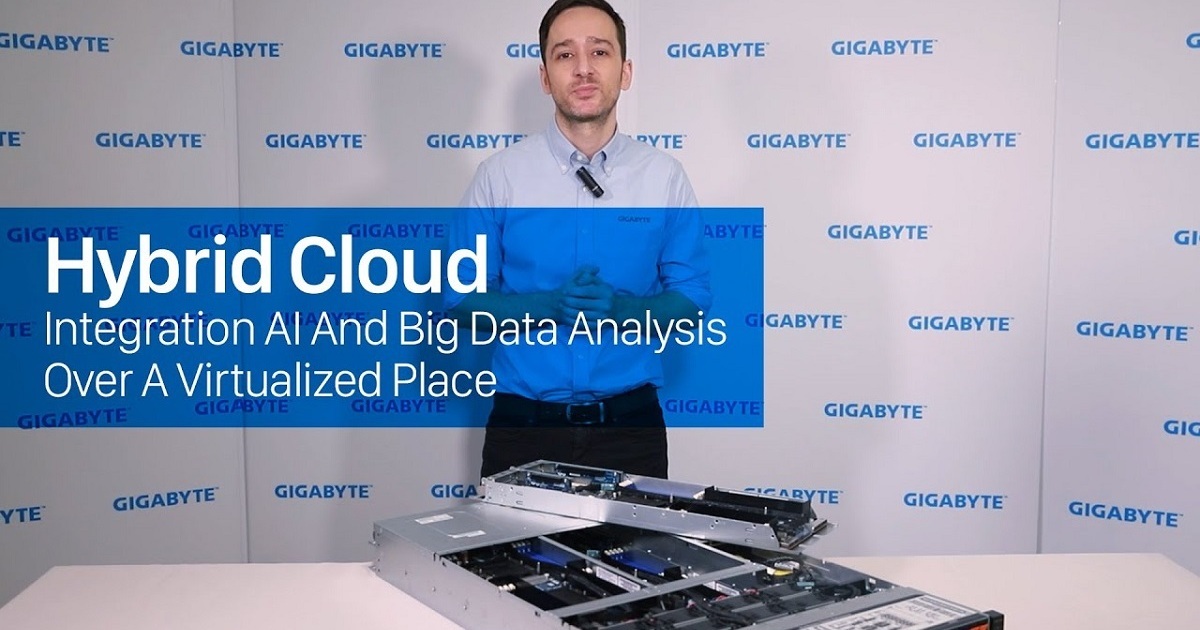
Hybrid Cloud: Integration AI and big data analysis over a virtualized place

Hybrid Cloud: Integration AI and big data analysis over a virtualized place

Hybrid Cloud: Integration AI and big data analysis over a virtualized place 0:10 What is a Hybrid Cloud, and why is it needed? 1:03 Advantages of GIGABYTE's ...
[Product] GIGABYTE R281-Z92

[Product] GIGABYTE R281-Z92

GIGABYTE's R281-Z92 is our 2U dual socket AMD EPYC server with 24 x 2.5" NVMe all-flash storage capacity. Please visit ...
WEKA Storage

WEKA Storage

A data platform built for speed, scalability, and efficiency across demanding environments
OCP ORv3 Solution

OCP ORv3 Solution

The alternative of power-efficient server solutions.
3rd Gen Intel Xeon Scalable Server Solutions

3rd Gen Intel Xeon Scalable Server Solutions

GIGABYTE servers and Intel Xeon Scalable Processors deliver incredible UP/DP performance from edge to data center with incredible gains in I/O throughput and workload demands that need high performing CPUs with large, optimized, memory configurations.
Silicon Valley Startup Sushi Cloud Rolls Out Bare-metal Services with GIGABYTE
Article

Silicon Valley Startup Sushi Cloud Rolls Out Bare-metal Services with GIGABYTE

The Silicon Valley startup Sushi Cloud is competing in the public cloud sector by providing “bare-metal” services that give users exclusive access to individual, standalone servers on the cloud, resulting in a triple boost to performance, versatility, and reliability. Sushi Cloud purchased GIGABYTE’s R152-Z30 Rack Servers to offer its clients the state-of-the-art performance of AMD EPYC™ CPUs; the versatility afforded by superb memory and storage capacities, in addition to OS and software ecosystem compatibility; and GIGABYTE’s proprietary high availability features (such as SCMP and dual ROM) and remote management functions (such as GIGABYTE Management Console and GIGABYTE Server Management).
Storage Systems are Extremely Important for Business Continuity
Article

Storage Systems are Extremely Important for Business Continuity

In an era of increasing technological advancement, an important issue for enterprises and the key to maintaining business continuity is how to prevent important data from being accidentally lost due to human error, deliberately deleted or even stolen.
GIGABYTE Direct Liquid Cooling Solution

GIGABYTE Direct Liquid Cooling Solution

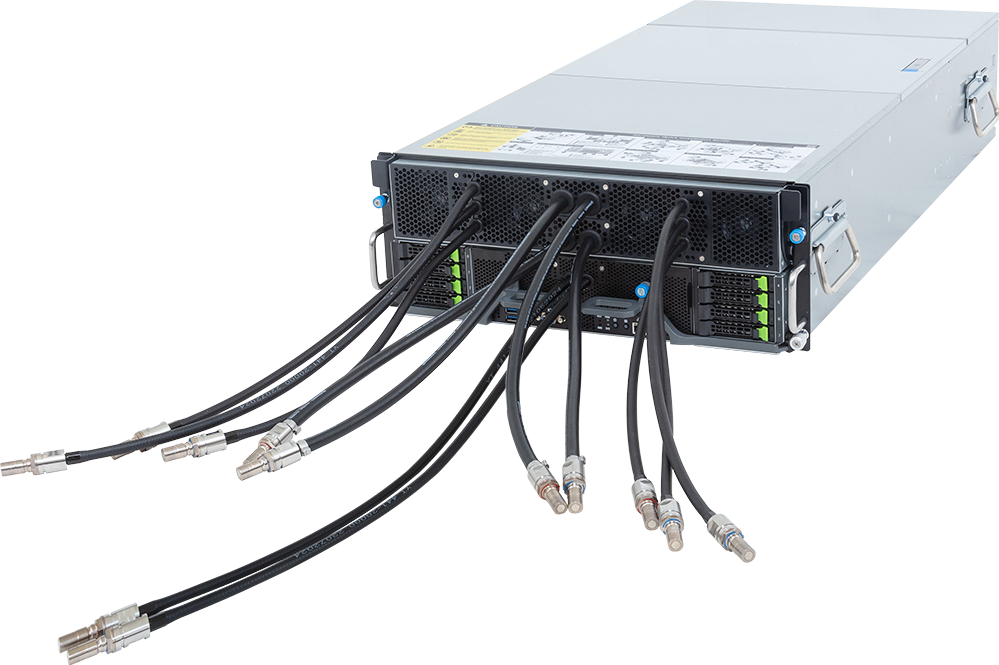
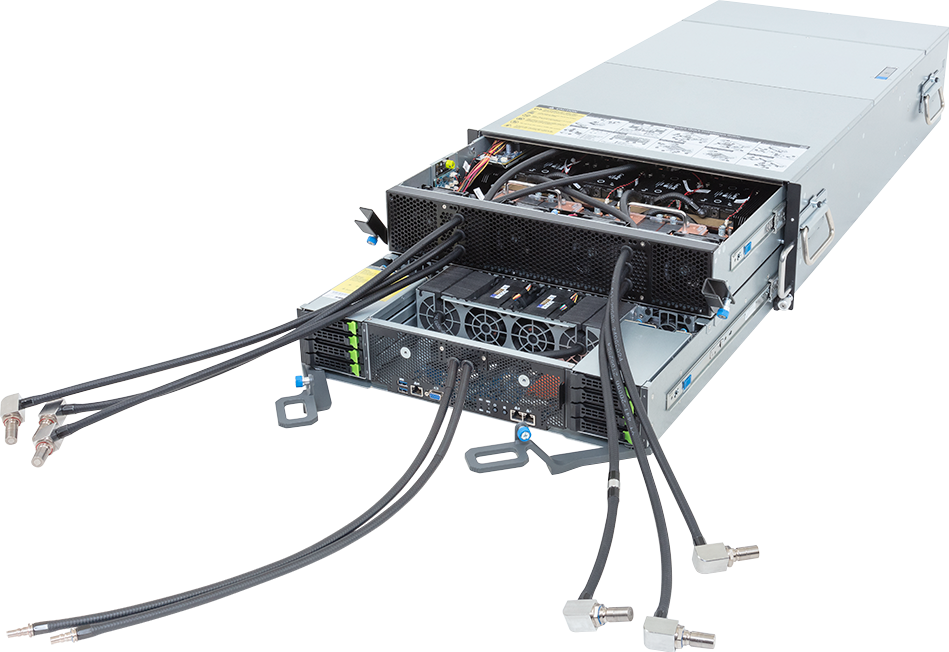
GIGABYTE Direct Liquid Cooling solution focuses on innovative breakthroughs in AI, HPC and cloud computing, delivering outstanding efficiency in heat dissipation while achieving high system availability and stability.
The Data Revolution in AI Factories: Driving High-Speed Networking Forward
Article

The Data Revolution in AI Factories: Driving High-Speed Networking Forward

Generative AI is accelerating the evolution of traditional data centers into next-generation AI Factories - massive, high-performance infrastructures purpose-built for intelligent workloads. In our first article, 《Ready or Not? The Era of AI Factory Has Arrived! AI Factory Era》, we introduced how GIGABYTE is redefining AI infrastructure with a holistic approach to reengineering AI infrastructure, enhancing compute performance, cooling efficiency, and system management. The second article, 《Revolutionizing the AI Factory: The Rise of CXL Memory Pooling》, highlighted that beyond powerful compute and memory, AI factories also demand reliable and ultra-fast data transmission. In this third installment, we focus on the backbone of AI infrastructure: high-speed networking. From single server interconnects to full-scale data center topologies, we’ll explore how cutting-edge transmission technologies enable massive GPU clusters, unlock seamless scalability, and power the AI workloads of tomorrow.
Giga Computing Expands GIGAPOD AI & HPC Infrastructure Platforms to Accelerate Deployment of Enterprise AI Factories

Giga Computing Expands GIGAPOD AI & HPC Infrastructure Platforms to Accelerate Deployment of Enterprise AI Factories