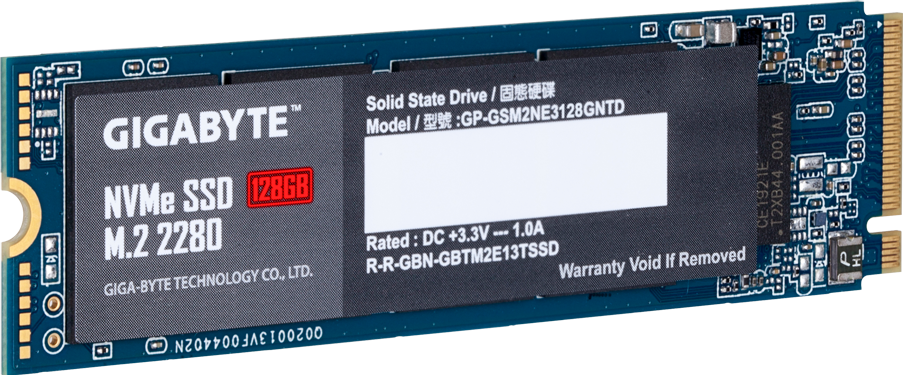
GIGABYTE NVMe SSD 128GB
GP-GSM2NE3128GNTD
Specifiche
- Interface
- PCI-Express 3.0 x4, NVMe 1.3
- Form Factor
- M.2 2280
- Total Capacity
- 128GB
- NAND
- NAND Flash
- External DDR Cache
- N/A
- Sequential Read speed
- Up to 1550 MB/s
- Sequential Write speed
- Up to 550 MB/s
- Random Read IOPS
- Up to 100k
- Random Write IOPS
- Up to 130k
- Dimension
- 80 x 22 x 2.3 mm
- Mean time between failure (MTBF)
- 1.5M hours
- Max. Operating Power
- Read:2.2W
Write:1.7W
- Power Consumption (Idle, PS3)
- 30mW
- Power Consumption(PS4, L1.2)
- 5mW
- Temperature (Operating)
- 0°C to 70°C
- Temperature (Storage)
- -40°C to 85°C
- Warranty
- 1. Limited 5-years or 110TBW.
- 2. Limited warranty based on 5 years or 110TBW, whichever comes first. (*TBW is evaluated by JEDEC workload standard. )
*TBW (Terabyte Written): Terabytes Written is the total amount of data that can be written into a SSD before it is likely to fail. - 3. When the usage of an NVME SSD as indicated by the "Percentage Used" (SMART ID: 05) in SMART page of "GIGABYTE SSD toolbox" reaches 100 means out of warranty. (A new unused product will show the number of 0)
- Note
- • Test system configuration: configuration may vary by models, we will choose the latest platform for verification.
- • Performance may vary based on SSD's firmware version and system hardware & configuration. Sequential performance measurements based on CrystalDiskMark and IOmeter 1.1.0.
- • Speeds based on internal testing. Actual performance may vary.
- • 1GB = 1 billion bytes. Actual useable capacity may vary.
- Interface
- PCI-Express 3.0 x4, NVMe 1.3
- Form Factor
- M.2 2280
- Total Capacity
- 128GB
- NAND
- NAND Flash
- External DDR Cache
- N/A
- Sequential Read speed
- Up to 1550 MB/s
- Sequential Write speed
- Up to 550 MB/s
- Random Read IOPS
- Up to 100k
- Random Write IOPS
- Up to 130k
- Dimension
- 80 x 22 x 2.3 mm
- Mean time between failure (MTBF)
- 1.5M hours
- Max. Operating Power
- Read:2.2W
Write:1.7W
- Power Consumption (Idle, PS3)
- 30mW
- Power Consumption(PS4, L1.2)
- 5mW
- Temperature (Operating)
- 0°C to 70°C
- Temperature (Storage)
- -40°C to 85°C
- Warranty
- 1. Limited 5-years or 110TBW.
- 2. Limited warranty based on 5 years or 110TBW, whichever comes first. (*TBW is evaluated by JEDEC workload standard. )
*TBW (Terabyte Written): Terabytes Written is the total amount of data that can be written into a SSD before it is likely to fail. - 3. When the usage of an NVME SSD as indicated by the "Percentage Used" (SMART ID: 05) in SMART page of "GIGABYTE SSD toolbox" reaches 100 means out of warranty. (A new unused product will show the number of 0)
- Note
- • Test system configuration: configuration may vary by models, we will choose the latest platform for verification.
- • Performance may vary based on SSD's firmware version and system hardware & configuration. Sequential performance measurements based on CrystalDiskMark and IOmeter 1.1.0.
- • Speeds based on internal testing. Actual performance may vary.
- • 1GB = 1 billion bytes. Actual useable capacity may vary.
* I materiali qui forniti sono solo di riferimento. GIGABYTE si riserva il diritto di modificare o rivedere il contenuto in qualsiasi momento senza preavviso.
* Le prestazioni pubblicate si basano su valori massimi teorici fornite dai rispettivi fornitori di chipset o organizzazione che hanno definito le specifiche di interfaccia. Le prestazioni effettive possono variare in base alla configurazione del sistema.
* Tutti i marchi ei loghi sono di proprietà dei rispettivi titolari.
* A causa dell'architettura standard del PC, una certa quantità di memoria è riservata al sistema e quindi la capacità di memoria reale è inferiore a quella dichiarata.
* Le prestazioni pubblicate si basano su valori massimi teorici fornite dai rispettivi fornitori di chipset o organizzazione che hanno definito le specifiche di interfaccia. Le prestazioni effettive possono variare in base alla configurazione del sistema.
* Tutti i marchi ei loghi sono di proprietà dei rispettivi titolari.
* A causa dell'architettura standard del PC, una certa quantità di memoria è riservata al sistema e quindi la capacità di memoria reale è inferiore a quella dichiarata.