ラックサーバー

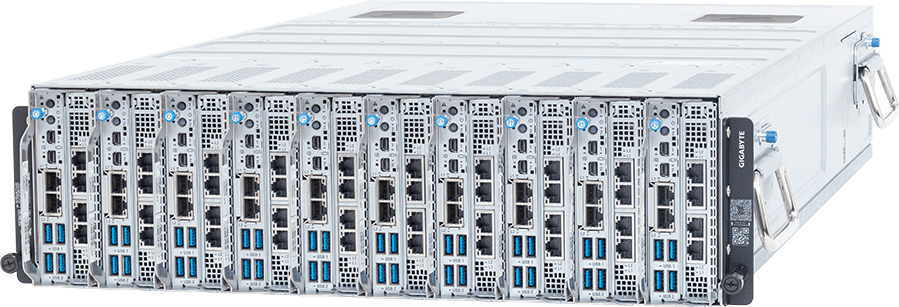
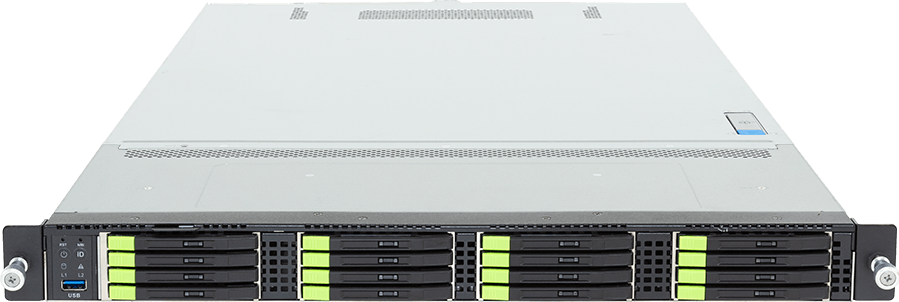
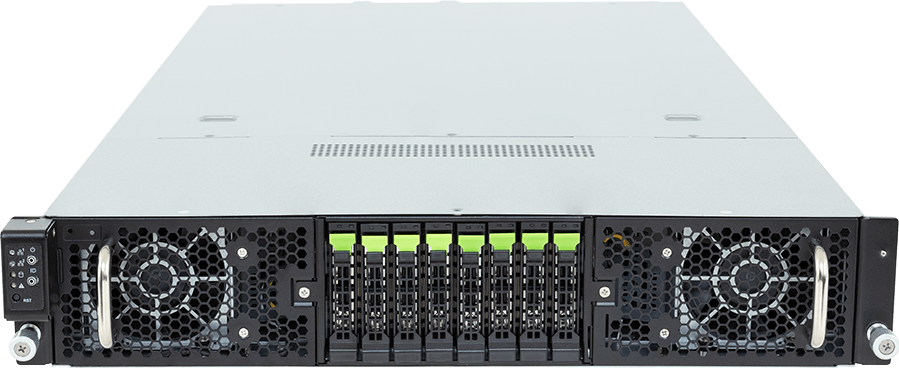
Rack servers delivering high scalability and flexibility, optimized for demanding data center applications. Available in 1U to 5U rack densities, with support for single and multi-socket configurations for x86 processors from AMD and Intel, as well as ARM processors from Ampere, extensive DDR5 memory, and hot-swappable storage drives.

Applications Include :

  • Big Data
  • High Performance Computing (HPC)
  • Hyper-converged infrastructure (HCI)
  • Software-defined Storage (SDS)
  • Virtualization
GIGABYTE ラックサーバー
フィルター
Platform
Cooling Type
Processor Vendor
CPU Series
CPU Type
CPUs
Form Factor
GPU Type
GPUs
LAN Speed
LAN Ports
DIMM Slots
Drive Bays
Certifications
CXL memory expansion
SupremeRAID
CPU Power
Application

G295

2U GPU Centric (2)
Copy Series Link
2U GPU Centric GPU-Server G295
  • CPU Type
  • DIMM Slots
  • LAN Speed
  • LAN Ports
  • Drive Bays
  • PSU
  • Cooling Type
  • AMD EPYC 9006 SP8
  • 16
  • 10 Gb/s
  • 2
  • 8 x 2.5"
  • Dual 3000 W
  • AMD EPYC 9006 SP7
  • 12
  • 10 Gb/s
  • 2
  • 8 x 2.5"
  • Dual 3000 W

H275

2U DP High Density (1)
Copy Series Link
2U DP High Density High-Density-Server H275
  • CPU Type
  • DIMM Slots
  • LAN Speed
  • LAN Ports
  • Drive Bays
  • PSU
  • Cooling Type
  • AMD EPYC 9006 SP8
  • 96
  • --
  • 0
  • 12 x E1.S
  • Quad 3200 W

H255

2U UP High Density (1)
Copy Series Link
2U UP High Density High-Density-Server H255
  • CPU Type
  • DIMM Slots
  • LAN Speed
  • LAN Ports
  • Drive Bays
  • PSU
  • Cooling Type
  • AMD EPYC 9006 SP8
  • 64
  • --
  • 0
  • 8 x E1.S
  • Dual 3000 W

H245

2U UP High Density (1)
Copy Series Link
2U UP High Density High-Density-Server H245
  • CPU Type
  • DIMM Slots
  • LAN Speed
  • LAN Ports
  • Drive Bays
  • PSU
  • Cooling Type
  • AMD EPYC 9006 SP8
  • 48
  • --
  • 0
  • 12 x E1.S
  • Quad 3200 W

G3L5

3U GPU Centric (1)
Copy Series Link
3U GPU Centric GPU-Server G3L5
  • CPU Type
  • DIMM Slots
  • LAN Speed
  • LAN Ports
  • Drive Bays
  • PSU
  • Cooling Type
  • AMD EPYC 9006 SP7
  • 32
  • 1 Gb/s
  • 1
  • 12 x 2.5"
  • 54 V bus bar

G495

4U GPU Centric (3)
Copy Series Link
4U GPU Centric GPU-Server G495
  • CPU Type
  • DIMM Slots
  • LAN Speed
  • LAN Ports
  • Drive Bays
  • PSU
  • Cooling Type
  • AMD EPYC 9006 SP7
  • 32
  • 10 Gb/s
  • 2
  • 12 x 2.5"
  • Quad 3200 W
  • AMD EPYC 9006 SP7
  • 32
  • 10 Gb/s
  • 2
  • 12 x 2.5"
  • Quad 3200 W
  • AMD EPYC 9006 SP7
  • 32
  • 10 Gb/s
  • 2
  • 4 x 2.5"
  • Quad 3200 W

H295

2U DP High Density (1)
Copy Series Link
2U DP High Density High-Density-Server H295
  • CPU Type
  • DIMM Slots
  • LAN Speed
  • LAN Ports
  • Drive Bays
  • PSU
  • Cooling Type
  • AMD EPYC 9006 SP7
  • 128
  • --
  • 0
  • 8 x E1.S
  • Quad 3200 W

G2L5

2U GPU Centric (1)
Copy Series Link
2U GPU Centric GPU-Server G2L5
  • CPU Type
  • DIMM Slots
  • LAN Speed
  • LAN Ports
  • Drive Bays
  • PSU
  • Cooling Type
  • AMD EPYC 9006 SP7
  • 32
  • 1 Gb/s
  • 1
  • 8 x E1.S
  • 54 V bus bar

Rack Server FAQ

What is a rack server?

A rack server is a server designed to be installed in a standard rack cabinet, typically built in a flat, horizontal form factor with mounting rails so that multiple servers can be stacked neatly within the same rack. This design makes rack servers well-suited for data center environments.
A server is a general term for a computer that provides computing resources to other devices on a network. A rack server is a specific server form factor designed to be mounted in a standard rack. Other common form factors include tower servers, which stand upright like desktop PCs, and blade servers, which fit into a shared blade chassis.
The "U" stands for rack unit, a standardized unit of height in equipment racks. One rack unit equals 1.75 inches (44.45 mm). A 1U server occupies one unit of vertical space in the rack, a 2U server takes up two units, and so on. The larger the U size, the more internal space the server usually has for components, cooling, and expansion.
Rack servers are space-efficient, allowing multiple servers to be housed in a single rack. This makes cable routing and maintenance more organized, and simplifies management in data center environments.