In the Quest for Higher Learning, High Density Servers Hold the Key
Success Case by GIGABYTE
A top technological university in Europe noticed rising demand for computing services across its various departments. It decided to build a next-generation data center with GIGABYTE's high density servers. With the right tools in place, scientists were able to accelerate their research, analyze massive amounts of information, and complete more data-intensive projects. Science advanced while the institute flourished.

5 min read
Thinking Outside the Box: GIGABYTE's Industry-Leading High Density Servers
In August of 2019, GIGABYTE led the market by announcing the H262 Series of High Density Servers, bringing the next generation of AMD EPYC™ processors to customers around the world. The H262 Series was the first to support up to 64 cores per CPU and up to 280W TDP. At the time of its release, it featured the highest density of any air-cooled server available on the market. Its impressive computing power and reliability amazed competitors and clientele alike, making it the natural choice for many High Performance Computing (HPC) system integrators, as well as the go-to solution for building a data center. 《Recommended for you: The EPYC Rise of AMD's New Server Processor》
Faster Servers Can Propel Academic Research to New Heights
One such client was an illustrious European technological university. As a research university, its strength is in fields of study that include engineering science, biochemistry, natural science, civil engineering, and mathematics. The academy is the alma mater of many renowned scientists; its contribution to the pursuit of knowledge is undisputed. Its researchers are supported by the large-scale simulation laboratory and data center available on the campus, which cements the institute's position as a champion of scientific research.
As computing technology continues to progress, it is imperative for the university to build the tools to process large quantities of data on very short notice. The university elected to establish a next-generation data center to upgrade its research capabilities and fulfill the demand for high performance computing.
As computing technology continues to progress, it is imperative for the university to build the tools to process large quantities of data on very short notice. The university elected to establish a next-generation data center to upgrade its research capabilities and fulfill the demand for high performance computing.

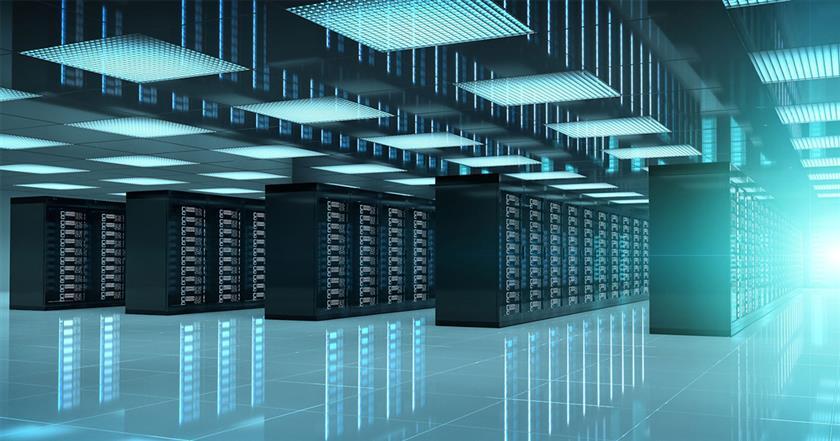
With next-generation data centers, it is now possible to quickly complete data-intensive computing tasks that are necessary for scientific research and data analysis.
Every Inch Counts: the Benefit of High Density Servers
The technological university selected GIGABYTE's H262-Z63, the High Density Server specially designed for supercomputers. Within a narrow 2U chassis, eight 64-core AMD EPYC™ processors were installed to take care of the data center's intense workload with cutting-edge computing power. Complex and extensive computing tasks or data analyses, which are sometimes required by academic research and experiments, could be completed on very short notice or within a limited period of time. The transmission performance of the I/O ports and the digital bandwidth were also improved. As a result, the security of processors, applications, and data was greatly enhanced.《Recommended for you: About GIGABYTE's High Density Server Series》
The chassis of the H262-Z63 houses both the fan system and the power supply, reducing energy consumption and cost of maintenance. The in-built Chassis Management Controller (CMC) monitors the four nodes simultaneously, resulting in less Top of Rack (ToR) cabling and switch connections. This helps to make the entire server easier to manage. The performance and computing power of a single H262-Z63 is nearly that of four standard 1U servers. However, it needs only half the space; it reduces power consumption by 4% and the number of power supply units by 75%; and it lowers the overall number of cables (including for power and 1GbE connection) by 56%. The customer's total cost of ownership is cut drastically as a result.
The chassis of the H262-Z63 houses both the fan system and the power supply, reducing energy consumption and cost of maintenance. The in-built Chassis Management Controller (CMC) monitors the four nodes simultaneously, resulting in less Top of Rack (ToR) cabling and switch connections. This helps to make the entire server easier to manage. The performance and computing power of a single H262-Z63 is nearly that of four standard 1U servers. However, it needs only half the space; it reduces power consumption by 4% and the number of power supply units by 75%; and it lowers the overall number of cables (including for power and 1GbE connection) by 56%. The customer's total cost of ownership is cut drastically as a result.
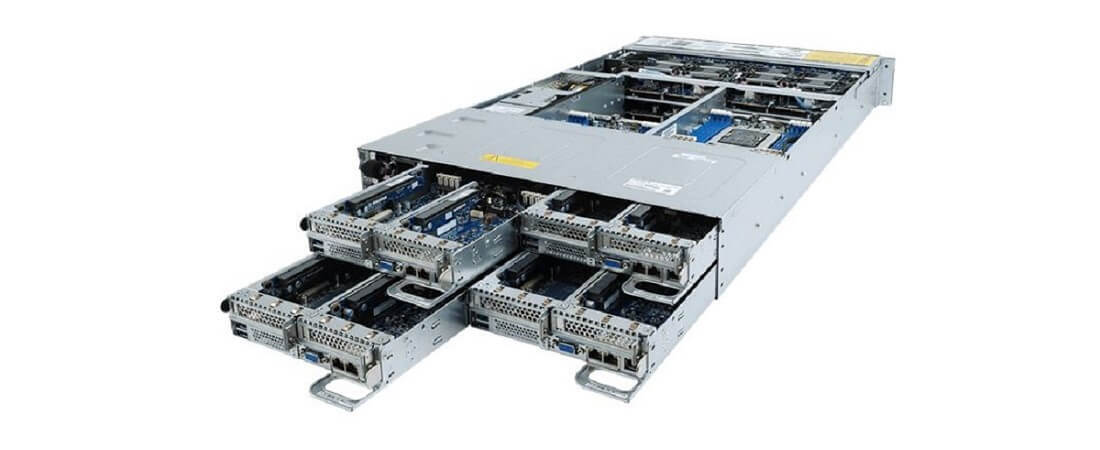
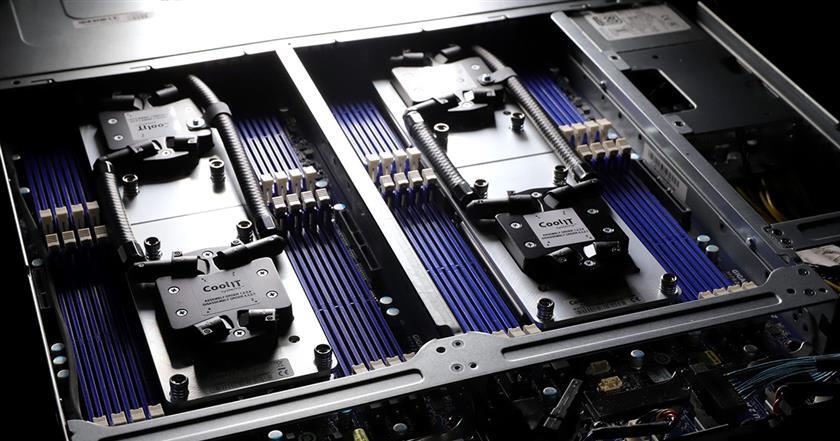
The H262-Z63 Series of High Density Servers can engage in high performance computing in a very limited amount of space.
High Density Servers Showcase Peak Performance and Optimal Reliability
In terms of system control, a High Density Server with four nodes in a 2U chassis is much more complicated than a 1U server. GIGABYTE combined innovative research and development with in-depth experience to help the processor achieve around 4.2 TeraFLOPS (one trillion floating point operations per second) in the LINPACK benchmark for HPC. This record-shattering performance outstrips competing devices in the same class.
The H262-Z63 performed excellently thanks to three technological breakthroughs:
1. Structural and system design
- The interconnected motherboard and optimized design solve the problems of high-speed data transfer and high power consumption.
- The back-up power supply makes it possible for all four independent nodes to remain in stable operation even if one power supply should fail, increasing the system's overall reliability.
2. Optimal heat dissipation
- Based on input from internal temperature sensors or changes in external temperature as detected by the remote board control chipset, individual fan speed will be automatically adjusted to achieve optimal heat dissipation and power conservation.
- The chassis design includes additional vents to improve airflow and reduce wind resistance, enhancing the motherboard's cooling efficiency.
- Fan ducts are used to increase wind pressure, thereby solving ventilation and heat dissipation problems in the nodes of high density servers.
3. Hardware design supplemented by software calibrations
- Hardware configurations such as memory cards and network adapters are selected according to user scenario.
- Software settings such as BIOS and BMC can be adjusted to optimize system performance. For example, the temperature, power consumption, and effectiveness of individual components can be monitored. System workload can be cut down by shutting off non-operational components.
GIGABYTE Management Platform and Software Give Customers Bigger Savings
GIGABYTE Server Management (GSM) is GIGABYTE's multiple server remote management software platform, available as a free download for all of GIGABYTE's server products. Customers can remotely manage their servers to reap the benefits of two outstanding features: A. the Baseboard Management Controller, which supports the latest Redfish® API-Application Programming Interface; B. support of Open Source, which is available for adoption and updates at any time.
When it comes down to it, GIGABYTE's High Density Servers provide excellent computing performance while maximizing data transfer rates. Not only can they deal with the heavy workloads of a research institute's data center, they are also recommended for other diverse scenarios, such as the computer facilities of small and medium enterprises, deep learning and machine learning, big data analytics and storage, and the construction of hyper-converged infrastructure (HCI). Because of this, GIGABYTE's High Density Servers are the number one choice for clients from various different sectors.
Learn More:
When it comes down to it, GIGABYTE's High Density Servers provide excellent computing performance while maximizing data transfer rates. Not only can they deal with the heavy workloads of a research institute's data center, they are also recommended for other diverse scenarios, such as the computer facilities of small and medium enterprises, deep learning and machine learning, big data analytics and storage, and the construction of hyper-converged infrastructure (HCI). Because of this, GIGABYTE's High Density Servers are the number one choice for clients from various different sectors.
Learn More: