GIGABYTE Server and GRAID SupremeRAID™
Tech Guide by GIGABYTE
Solutions that deliver NVMe SSD performance without sacrifice data security and business continuality

6 min read
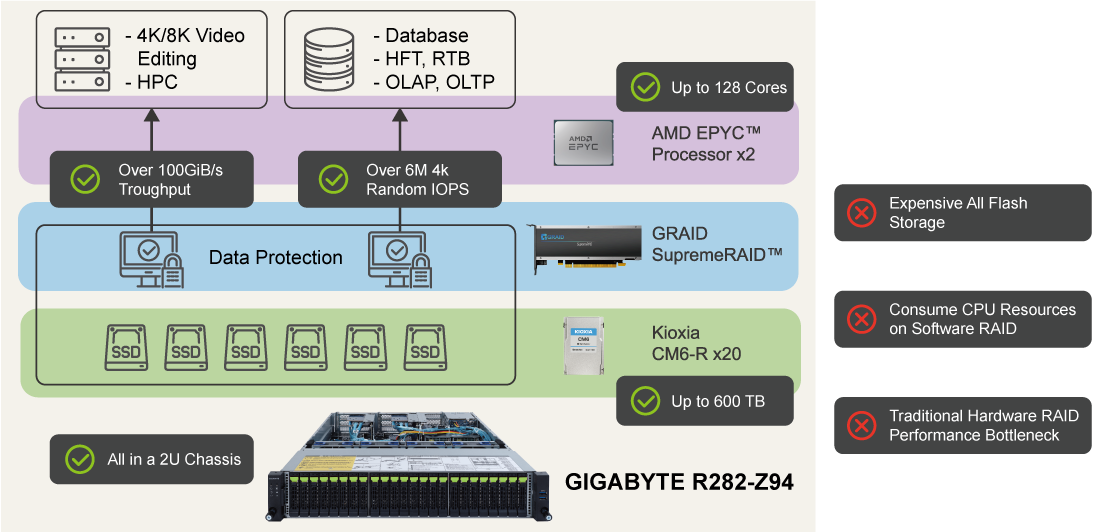
While traditional RAID technology has become the bottleneck of SSD disks, GRAID Technology has developed a disruptive software + hardware solution to unlock the performance bottleneck of RAID protection for SSDs. GRAID SupremeRAID works by installing a virtual NVMe controller onto the operating system and integrating a PCIe device into the system equipped with a high-performance AI processor to handle all RAID operations of the virtual NVMe controller.
This setup offers many advantages:
This setup offers many advantages:
- Takes full advantage of NVMe performance – 6 million random IOPS and 100 GiB/s throughput which is currently the industry leading performance benchmark
- Unlike traditional Software RAID it does not consume a large amount of CPU resources
- Overcomes the limitations of Hardware RAID cards, such as computing performance, PCIe bandwidth, number of SSD support and the effort of battery maintenance etc
- Plug and play, and can be used even for systems without PCIe switches that used SSDs directly connected to the CPU via PCIe without needing to change the hardware design
- SCI (Software Composable Infrastructure) compatible and can be used for external SSDs connected via NVMeOF
- Highly scalable, and new software functions such as compression and encryption can easily be added
INDUSTRIES
- Online transaction processing (OLTP) and online analytical processing (OLAP)
- Real-time editing of 4K/8K video content
- HPC and technical computing
- High-frequency trading (HFT) and real-time bidding (RTB)
- Large SQL and NoSQL database processing
CHALLENGES
With various of the workloads that require the performance of NVMe SSD, to protect the business continuality, using traditional RAID becomes a challenge to get the performance that NVMe SSD should performed. Existing solution in the market, no matter it’s software RAID or hardware RAID, are currently incapable to drive more than 4 NVMe SSDs. To get full power of NVMe SSD becomes too complex and not cost effective.
SOLUTIONS
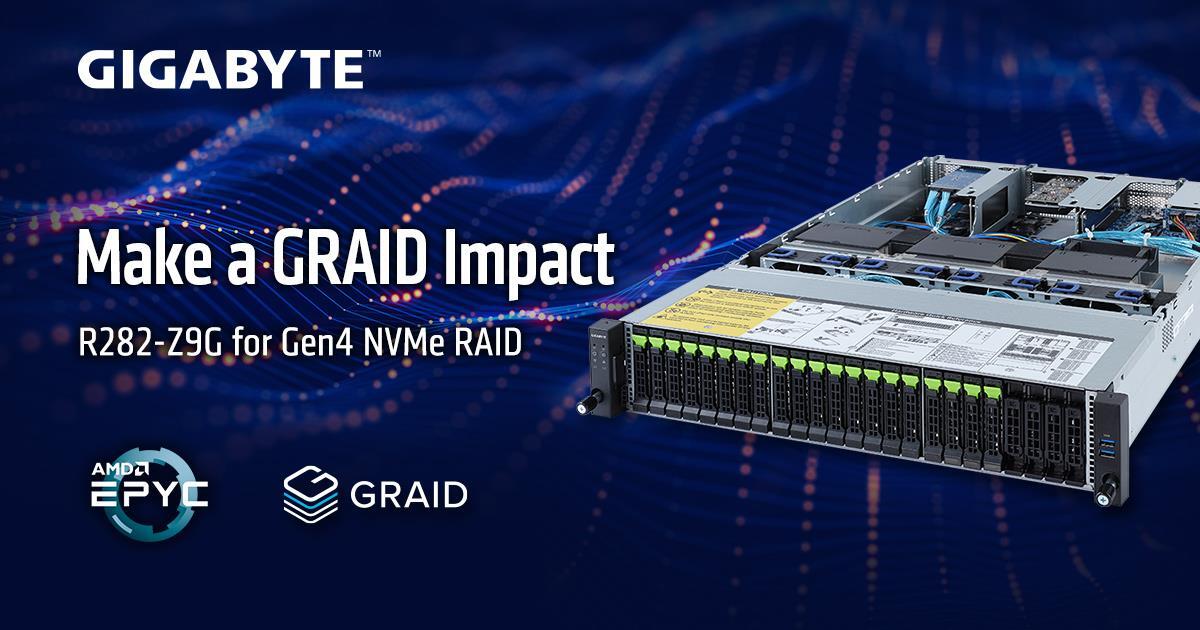
This solution uses the Kioxia CM6-R high-performance enterprise-class SSD, with the GIGABYTE R282-Z94 full NVMe server, and uses the GRAID SupremeRAID™ SR-1000 for data protection. The SupremeRAID™ SR-1000 can flexibly configure RAID groups for different performance requirements of workloads.
BENEFITS
This solution comes with 128-core CPU in a single 2U server, with storage capable of delivering more than 100 GiB/s of bandwidth, 6 million IOPS and up to 570 TB of usable space with comprehensive data protection at the same time, which greatly reduces system complexity and total cost of ownership.
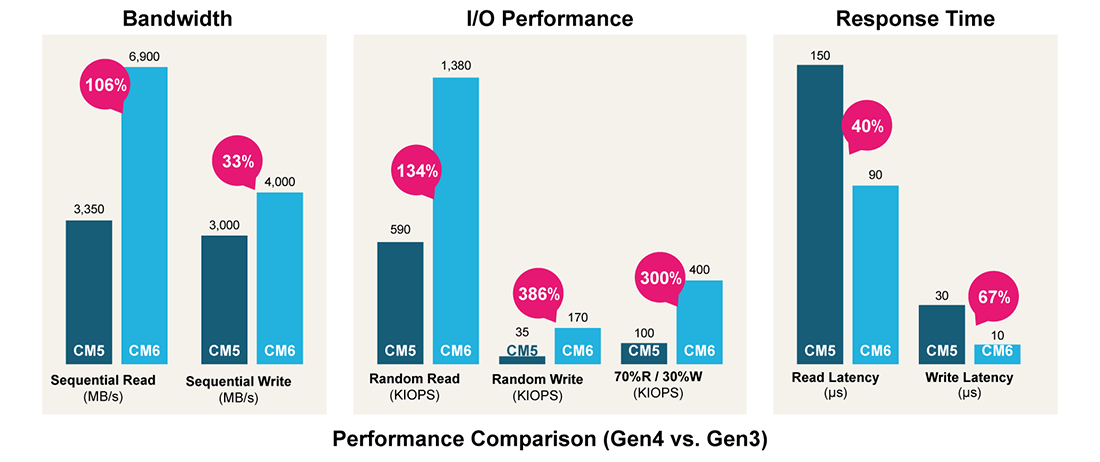
Deliver high performance for enterprise applications and workloads with CM6 Series Enterprise NVMe SSDs
Enterprise class NVMe SSDs are designed to deliver the highest performance standard in 24/7 workload. Kioxia CM6 series include such features as dual-port, high density, mix endurance grades, and high levels of data protection (data integrity checking, high reliability, media wear reporting and error reporting).
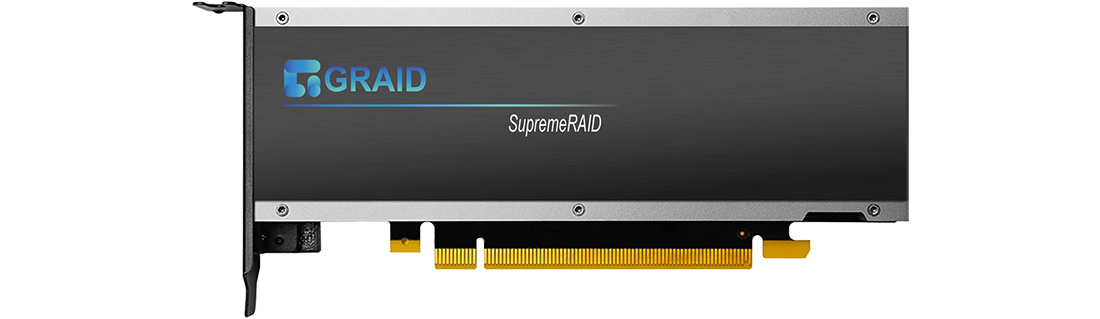
GRAID SupremeRAID™
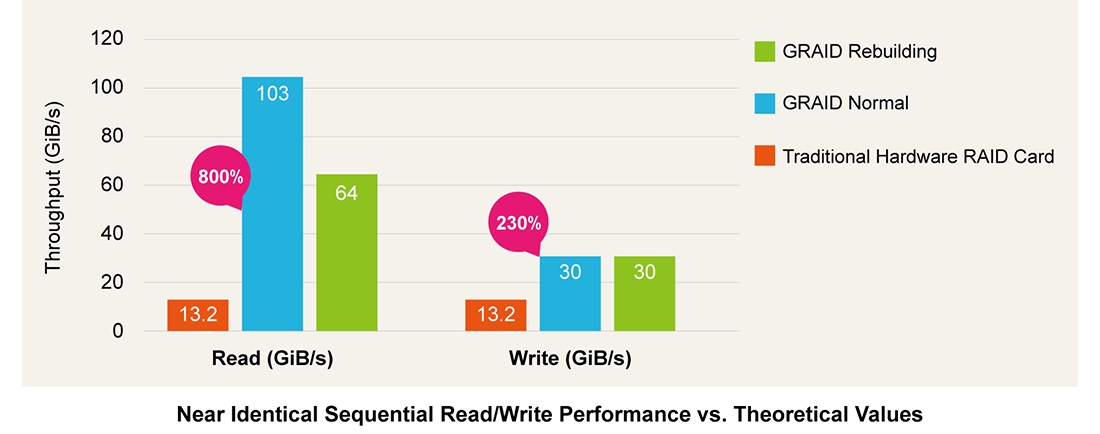
GRAID SupremeRAID™ is the most powerful, high-speed data protection solution specially designed for NVMe SSDs. The test results show that performance of different workloads can be met by the performance of different configurations. A RAID-5 group composed of 3 CM6-R SSDs designed for database, OLAP use cases can achieve 4671K IOPS random reads and 765K IOPS random writes and maintain extremely low latency. Even when a SSD is damaged, it can still sustains more than one million random read and write performance which will not impact the performance of the application at all. A RAID-5 group composed of 20 CM6-R SSDs can provide extremely high usable space, with 91 GiB/s sequential read and 7 GiB/s sequential write, it is a very perfect solution for applications that require read throughput like AI training, big data analysis...etc. Finally, a RAID-10 group composed of 20 CM6-R SSDs can provide 104 GiB/s sequential read and 30 GiB/s sequential write, which is almost 8 times the performance of a traditional hardware RAID card. When a SSD is damaged, it can still maintain a very high bandwidth and complete data reconstruction in very short time. Utilizing the high-speed and stable read and write performance of Kioxia CM6-R, combined with GRAID SupremeRAID™ data protection solution, GIGABYTE R282-Z94 server and AMD EPYC™ 7742 64 core processor, it can be applied to a variety of high-density computing in the most streamlined configuration without worrying about the performance bottleneck caused by data protection.
Leander Yu, CEO of GRAID Technology Inc., comments: “As we see 5G, AI and IoT workloads benefited from Kioxia’s powerful Gen4 NVMe SSD. To ensure the business continuality, GRAID Technology together with Kioxia and GIGABYTE, reveal the next generation of server, storage and data protection technology. Capable of delivering industrial leading performance. ”
Daniel Hou, VP of Networking and Communication Business Unit at GIGABYTE, comments: “With each generational leap there are more demanding workloads that require fast throughput from storage solutions. GIGABYTE has worked with GRAID Technology and Kioxia to develop industry leading performance for Gen 4 NVMe SSDs showcased in R282-Z94, that giving blazing fast performance in a storage dense 2U chassis.”
Daniel Hou, VP of Networking and Communication Business Unit at GIGABYTE, comments: “With each generational leap there are more demanding workloads that require fast throughput from storage solutions. GIGABYTE has worked with GRAID Technology and Kioxia to develop industry leading performance for Gen 4 NVMe SSDs showcased in R282-Z94, that giving blazing fast performance in a storage dense 2U chassis.”
GIGABYTE R282-Z94
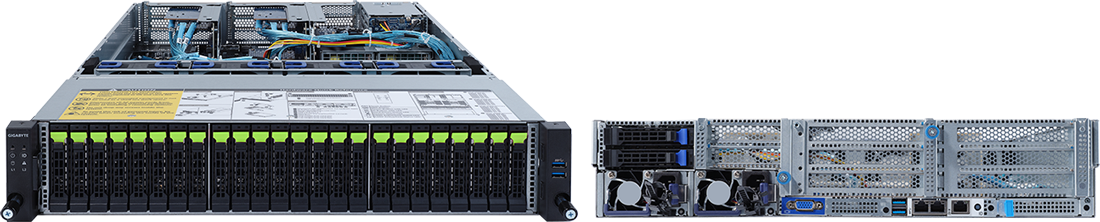
GIGABYTE R-series server – R282-Z94 is a full-flash server with the second-generation AMD EPYC™ processor. The second-generation AMD EPYC™ processor is based on 7nm advanced process technology to increase the number of cores to 64 groups and PCIe channels up to 128 and supports a new generation of PCIe 4.0 transmission interface. Based on these technical advantages, R282-Z94 provides powerful computing performance and can handle a large amount of data calculations in real time. In addition, properly use the rich PCIe channels to provide flexible PCIe expansion slots. It also supports 24 2.5-inch U.2 storage devices on the front side of the chassis to meet the needs of a large amount of real-time read/write data. GIGABYTE’s R282-Z94 has an optimized design with high-density computing, storage capacity configuration, and doubled I/O performance, which can meet the increasingly demanding workload requirements, such as software-defined and virtualized infrastructure, large-scale data analysis or all flash high-performance storage service, etc.
Future Collaboration
As NVMe SSD is replacing fundamental storage infrastructure, we see datacenter storage infrastructure design has become the biggest challenge moving forward. Especially when PCIe Gen4 emerges, industrial are looking for a solution that could deliver the NVMe SSD performance without sacrifice the data security and business continuality. GRAID SupermeRAID™ with future NVMeoF support delivers tremendous performance with comprehensive data protection and flexibility, not only resolve the performance bottleneck but also significantly reduce the TCO. Together with most powerful PCIe Gen4 SSD from Kioxia and the most advance Gen4 system from GIGABYTE, the solution reveals the true PCIe Gen4 performance without compromise the data security for all datacenter/enterprise workloads as a total solution to the customer. We expect to continue this cooperation to deliver more solutions to our customers.