LLM (Large Language Model)
What is LLM (Large Language Model)?
A large language model (LLM) is an artificial intelligence (AI) model that can comprehend human language without the need for additional programming, and also generate text that is indistinguishable from what's written by a human, through a process known as natural language processing (NLP). Popular LLMs on the market include OpenAI’s GPT-series, Meta’s LLaMA family, and the open-source BLOOM. Many language-based generative AI services have been built on the foundation of LLMs, such as OpenAI's ChatGPT, Google Bard, and Microsoft Bing Chat.
At its core, an LLM is an artificial neural network (ANN) that employs a type of deep learning architecture known as a "transformer". The parallel computing mechanism of the transformer allows it to engage in AI training using an enormous corpus of language-based big data—such as the entire Wikipedia—with data parameters numbering in the billions, or even trillions. During training, the AI model tries to guess the correct output to respond to a certain input—such as the next word in a sentence, or the appropriate response to a query—and then it checks its answers. Depending on whether it guessed correctly, the AI model adjusts the "biases" or "weights" of its data parameters, until it will almost always generate the right output. This is why AI services based on LLMs can understand and reply to human language with ease. Real-life examples include a customer support chatbot providing accurate responses to complaints that may be misspelled or grammatically incorrect, and ChatGPT composing poems and resumes in a matter of seconds.
Learn More: What Is RAG and How Does It Work?
At its core, an LLM is an artificial neural network (ANN) that employs a type of deep learning architecture known as a "transformer". The parallel computing mechanism of the transformer allows it to engage in AI training using an enormous corpus of language-based big data—such as the entire Wikipedia—with data parameters numbering in the billions, or even trillions. During training, the AI model tries to guess the correct output to respond to a certain input—such as the next word in a sentence, or the appropriate response to a query—and then it checks its answers. Depending on whether it guessed correctly, the AI model adjusts the "biases" or "weights" of its data parameters, until it will almost always generate the right output. This is why AI services based on LLMs can understand and reply to human language with ease. Real-life examples include a customer support chatbot providing accurate responses to complaints that may be misspelled or grammatically incorrect, and ChatGPT composing poems and resumes in a matter of seconds.
Learn More: What Is RAG and How Does It Work?
What are the applications of LLM?
Without LLMs, communicating with a computer would require the use of prompts (remember MS-DOS?) or a pre-designed graphical user interface (GUI). Expecting the computer to respond in human language would be a pipe dream. Thanks to the proliferation of LLMs, many new AI-based services have now become available:
● Search engines and chatbots: LLM technology has infused these popular functions with AI. Not only can search engines and chatbots understand our queries with incredible accuracy, but these features have also given rise to a new generation of AI-empowered personal computers and devices.
● Generative AI: Tools like ChatGPT can do anything from summarizing and translating documents to composing brand-new content like letters and TV scripts.
● Healthcare and medicine: Smart healthcare applications based on LLMs can generate electronic health records (EHR) that will lighten the administrative burden of medical workers and create databases for use in healthcare analytics.
● Programming and AI development: GitHub Copilot, which was developed by Microsoft and OpenAI, can write computer code in JavaScript, Python, and other programming languages. This is especially noteworthy, because in effect, LLMs have enabled AI to create the programming for future AI tools.
● Search engines and chatbots: LLM technology has infused these popular functions with AI. Not only can search engines and chatbots understand our queries with incredible accuracy, but these features have also given rise to a new generation of AI-empowered personal computers and devices.
● Generative AI: Tools like ChatGPT can do anything from summarizing and translating documents to composing brand-new content like letters and TV scripts.
● Healthcare and medicine: Smart healthcare applications based on LLMs can generate electronic health records (EHR) that will lighten the administrative burden of medical workers and create databases for use in healthcare analytics.
● Programming and AI development: GitHub Copilot, which was developed by Microsoft and OpenAI, can write computer code in JavaScript, Python, and other programming languages. This is especially noteworthy, because in effect, LLMs have enabled AI to create the programming for future AI tools.
How is GIGABYTE helpful?
GIGABYTE Technology offers both the hardware and software solutions for working with LLMs and generative AI services that are based on LLMs.
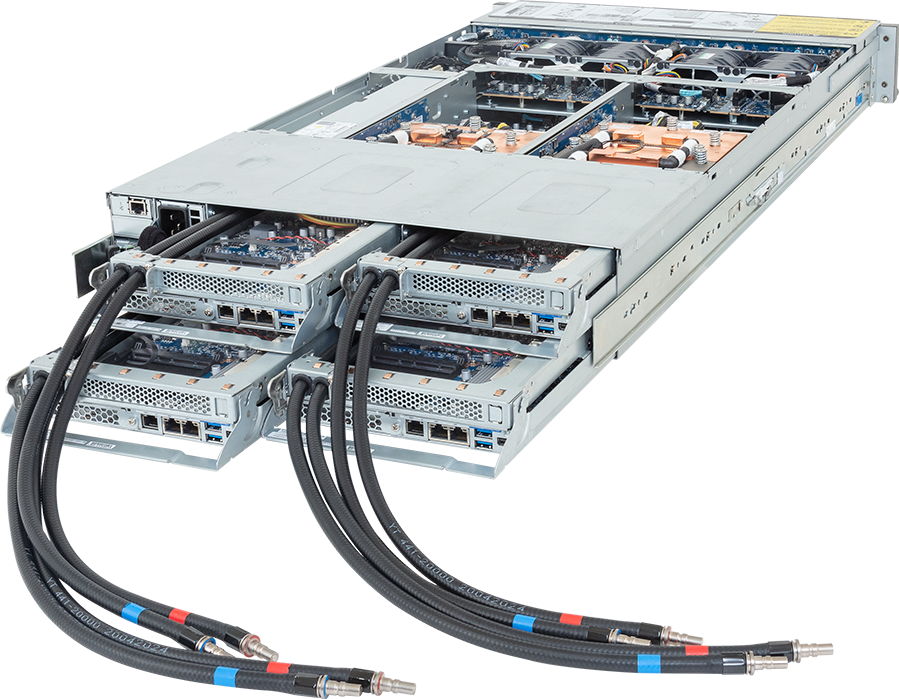
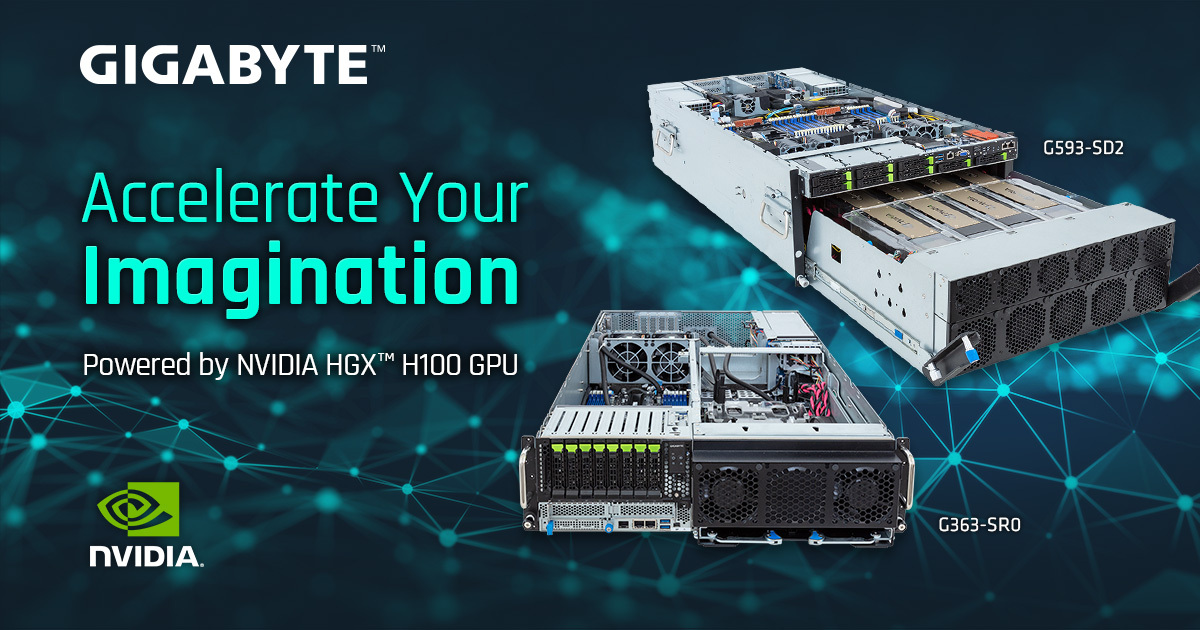
On the hardware side, GIGABYTE provides AI Servers that are uniquely suited for the computing and data storage aspects of training an AI model. For example, GIGABYTE G593-SD0 is the first NVIDIA-certified HGX™ H100 8-GPU SXM5 server on the market. It's integrated with NVIDIA's HGX™ H100 8-GPU computing module, which is why it is an incredibly powerful AI computing platform. Other products from GIGABYTE's lineup of G-Series GPU Servers can also be outfitted with advanced GPU accelerators, such as NVIDIA L40S, to support LLM workloads. For data storage, GIGABYTE's S183-SH0 S-Series Storage Server is specially designed for LLMs. It provides all-flash array (AFA) storage through the deployment of EDSFF E1.S solid-state drives (SSD), which benefit from PCIe Gen5 and NVMe interface technology, so the server can meet the high-speed data storage and retrieval requirements of LLM development.
On the software side, GIGABYTE’s investee company MyelinTek Inc. offers the MLSteam DNN Training System, which is an “MLOps Platform” that can support NLP and LLM applications. The MLSteam DNN Training System can optimize open-source LLMs like BLOOM for the GPU acceleration software platform of the client’s choice, such as AMD ROCm or NVIDIA CUDA.
On the hardware side, GIGABYTE provides AI Servers that are uniquely suited for the computing and data storage aspects of training an AI model. For example, GIGABYTE G593-SD0 is the first NVIDIA-certified HGX™ H100 8-GPU SXM5 server on the market. It's integrated with NVIDIA's HGX™ H100 8-GPU computing module, which is why it is an incredibly powerful AI computing platform. Other products from GIGABYTE's lineup of G-Series GPU Servers can also be outfitted with advanced GPU accelerators, such as NVIDIA L40S, to support LLM workloads. For data storage, GIGABYTE's S183-SH0 S-Series Storage Server is specially designed for LLMs. It provides all-flash array (AFA) storage through the deployment of EDSFF E1.S solid-state drives (SSD), which benefit from PCIe Gen5 and NVMe interface technology, so the server can meet the high-speed data storage and retrieval requirements of LLM development.
On the software side, GIGABYTE’s investee company MyelinTek Inc. offers the MLSteam DNN Training System, which is an “MLOps Platform” that can support NLP and LLM applications. The MLSteam DNN Training System can optimize open-source LLMs like BLOOM for the GPU acceleration software platform of the client’s choice, such as AMD ROCm or NVIDIA CUDA.