GenAI (Generative AI)
What is Generative AI (GenAI)?
Generative AI is a type of artificial intelligence that can generate brand-new content, (known as GenAI, AI generated content, or AIGC), in the form of texts, images, audio or video, based on user input. This was made possible by advancements in deep learning and neural network technology, which have made it feasible for AI models to work with natural language prompts—that is, the texts and images we humans already use to communicate with each other. In turn, this has enabled programmers to load the equivalent of Wikipedia—which is to say, a pre-existing database consisting of billions, if not trillions of parameters—into an AI model and teach it to engage in natural language processing (NLP) so that it can generate the appropriate responses. If the input is language-based, then the result may be a large language model (LLM), like BLOOM; or a chatbot based on such a model, like ChatGPT. If the input is image-based, then the result may be a text-to-image system like Stable Diffusion or Midjourney.
Learn More: Generative AI vs. Agentic AI: Defining the Next Evolution of AI
Learn More: Generative AI vs. Agentic AI: Defining the Next Evolution of AI
How does generative AI work?
Generative AI is able to do this thanks to a two-step development process comprising AI training and AI inference. During AI training, an enormous database of labeled data is loaded into the AI model. The AI tries to “guess” what the expected output is—whether it’s the next word in a sentence or the identification of symptoms in a medical image—and then it checks its answers. Through repeated iterations of predictions (forward propagations) and feedback (backward propagations), the AI adjusts the weighted scores of its data parameters so precisely that it begins to deliver the correct output every time. This is what’s known as a pre-trained AI model.
During AI inference, the AI model faces fresh, unlabeled data in the real world. Drawing from its extensive training, the model is able to generate the correct response. Its interactions with novel data will also be recorded so that it can be used in the next round of AI training, which will further optimize the AI model.
It should be noted that breakthroughs in AI development have made it possible for AI to engage in self-supervised or semi-supervised learning using unlabeled data. For this reason, generative AI is getting smarter and more sophisticated every day.
Read More: To Harness Generative AI, You Must Learn About “Training” & “Inference”
During AI inference, the AI model faces fresh, unlabeled data in the real world. Drawing from its extensive training, the model is able to generate the correct response. Its interactions with novel data will also be recorded so that it can be used in the next round of AI training, which will further optimize the AI model.
It should be noted that breakthroughs in AI development have made it possible for AI to engage in self-supervised or semi-supervised learning using unlabeled data. For this reason, generative AI is getting smarter and more sophisticated every day.
Read More: To Harness Generative AI, You Must Learn About “Training” & “Inference”
What are the applications of generative AI?
Generative AI is broadly used in a range of vertical markets and scenarios, from media and marketing to healthcare and product design. Below are a few examples of how generative AI is already being utilized to reshape our world.
● Healthcare: In healthcare and medicine, generative AI can be trained on a library of medical data so that it can help diagnose diseases or generate customized treatment plans based on the patient's medical history. It can be used in drug development to analyze molecular structures and design new drugs. Last but not least, using AI to generate electronic health records (EHR) can create a database for healthcare analytics while also reducing administrative work for the medical staff.
● Marketing: Generative AI can come up with marketing plans, campaigns, slogans, and visual designs in a jiffy. It can even create customized ad campaigns based on the projected preferences of different market segments.
● Media: Not only can generative AI help write TV scripts and press releases, but it can also produce images, audio, and video content using a minimum of training data. Rather than replacing human workers, AI can help content creators bring their visions to life more efficiently and effectively, so that they can make the most out of that elusive creative spark and produce a series of magnum opuses.
● Product design: AI can write computer code, generate product design blueprints, evaluate concepts, and even run simulations to see how different designs or materials would work in a real-life scenario. Even the process of designing the microchips and computer systems that run the AI can be expedited with generative AI, which can enable rapid prototyping and reduce time-to-market. Big data compiled from user feedback can be helpful in training the AI model to generate insightful suggestions for product design.
According to Bloomberg’s forecast, the generative AI market is expected to grow to US$1.3 trillion by 2032, achieving a compound annual growth rate (CAGR) of 42%.
● Healthcare: In healthcare and medicine, generative AI can be trained on a library of medical data so that it can help diagnose diseases or generate customized treatment plans based on the patient's medical history. It can be used in drug development to analyze molecular structures and design new drugs. Last but not least, using AI to generate electronic health records (EHR) can create a database for healthcare analytics while also reducing administrative work for the medical staff.
● Marketing: Generative AI can come up with marketing plans, campaigns, slogans, and visual designs in a jiffy. It can even create customized ad campaigns based on the projected preferences of different market segments.
● Media: Not only can generative AI help write TV scripts and press releases, but it can also produce images, audio, and video content using a minimum of training data. Rather than replacing human workers, AI can help content creators bring their visions to life more efficiently and effectively, so that they can make the most out of that elusive creative spark and produce a series of magnum opuses.
● Product design: AI can write computer code, generate product design blueprints, evaluate concepts, and even run simulations to see how different designs or materials would work in a real-life scenario. Even the process of designing the microchips and computer systems that run the AI can be expedited with generative AI, which can enable rapid prototyping and reduce time-to-market. Big data compiled from user feedback can be helpful in training the AI model to generate insightful suggestions for product design.
According to Bloomberg’s forecast, the generative AI market is expected to grow to US$1.3 trillion by 2032, achieving a compound annual growth rate (CAGR) of 42%.
How is GIGABYTE helpful?
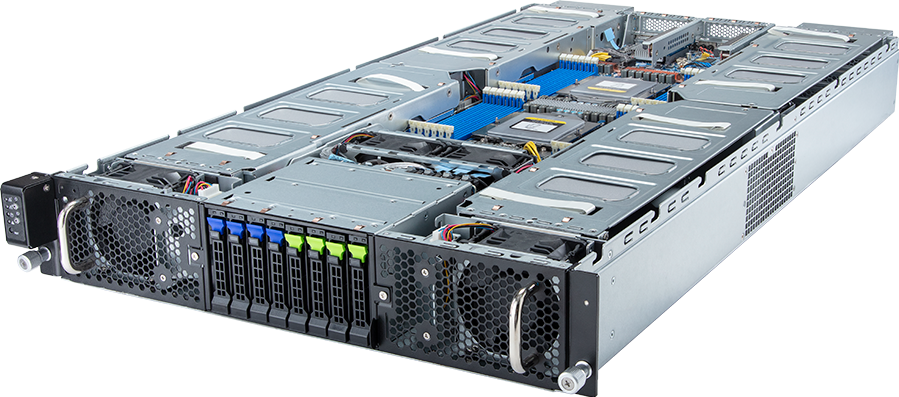
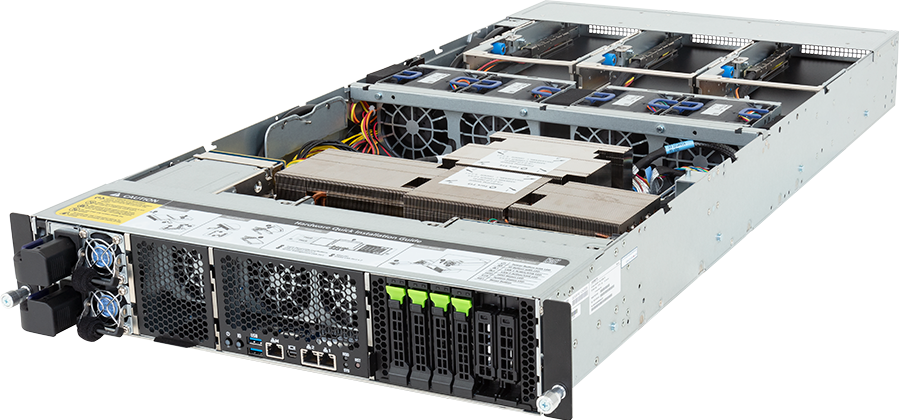
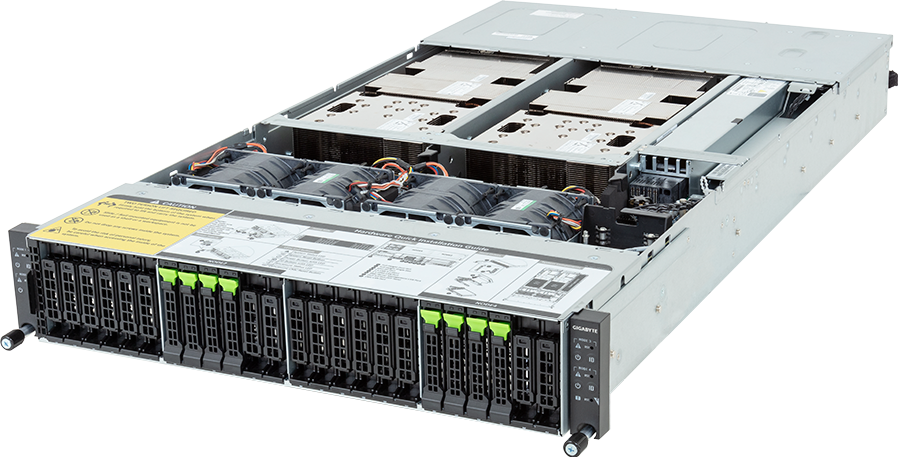
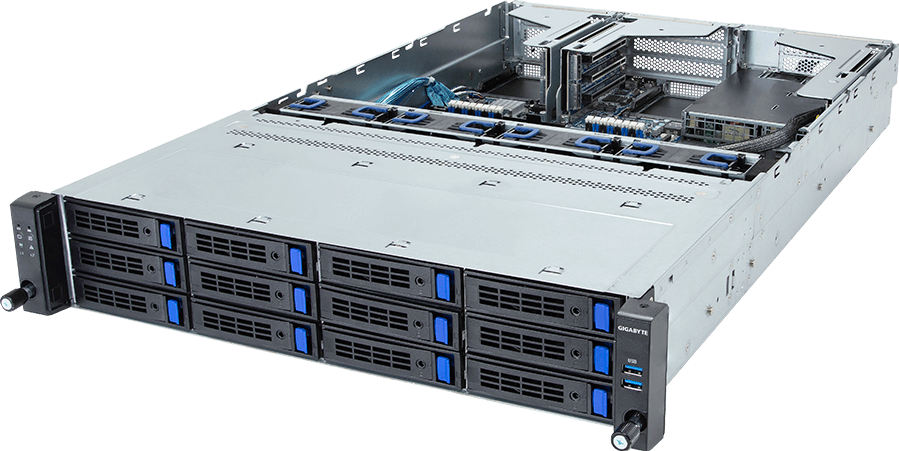
GIGABYTE Technology has a comprehensive line of AI Servers and AI infrastructure solutions that are ideal for developing and utilizing generative AI models. The solutions can be separated into two categories that reflect their role in AI training or inference.
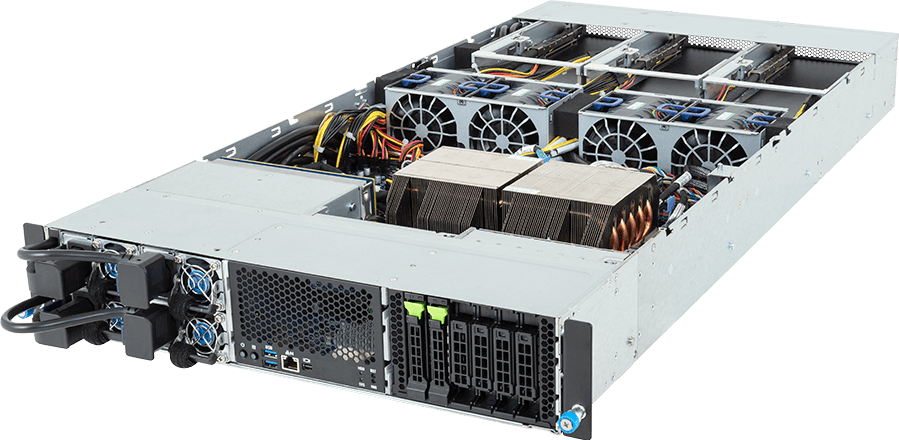
● AI training: These servers utilize the most advanced GPU accelerators and computing modules—or even an advanced type of processors that combine the functions of CPUs and GPUs into one package—to engage in parallel computing and deal with an enormous dataset to train the AI. A prime example is GIGABYTE G593-SD0, which integrates NVIDIA's HGX™ H100 8-GPU computing module to create one of the most powerful AI training platforms on the market. GIGABYTE servers also support NVIDIA L40S GPUs. Another exciting option is the “CPU plus GPU” chip that’s aimed at AI and HPC workloads. Options include AMD Instinct™ MI300A, which is AMD’s enterprise-grade APU (accelerated processing unit), and the NVIDIA Grace Hopper™ Superchip, which is available on GIGABYTE H-Series High Density Servers like the H223-V10.
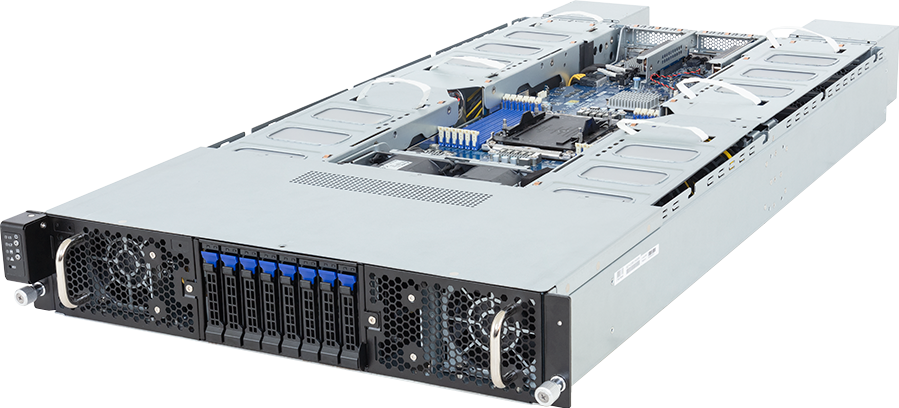
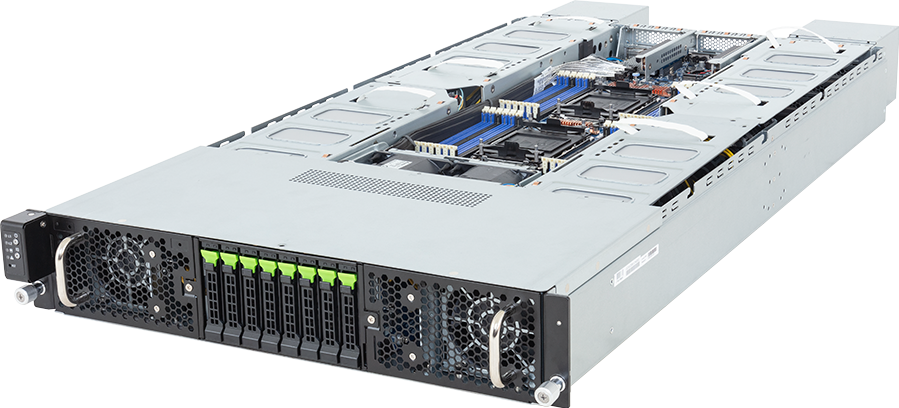
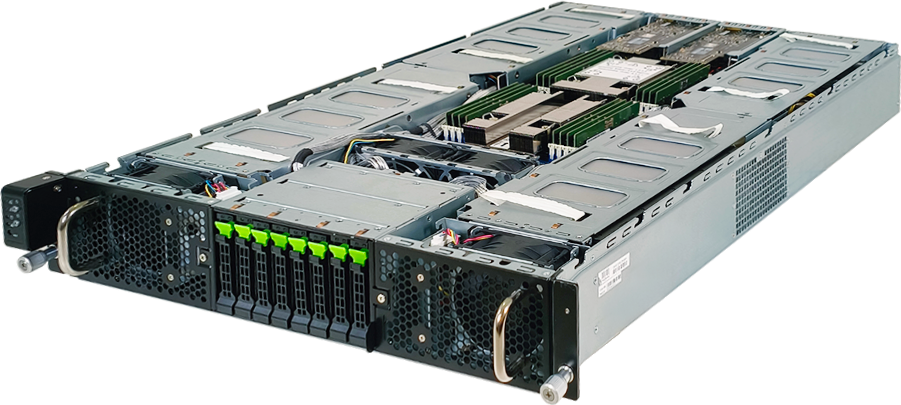
● AI inference: Specialized accelerators best suited for AI inference should be chosen for this stage of generative AI work. GIGABYTE G293-Z43 is designed to house a highly dense configuration of sixteen AMD Alveo™ V70 cards in a 2U chassis. These accelerators adopt a dataflow architecture that makes them the ideal solution for centralized, intensive AI inference workloads. GIGABYTE servers with PCIe Gen 4 (or above) expansion slots are also compatible with NVIDIA A2 Tensor Core GPUs and L4 Tensor Core GPUs, which can aid AI inference. Qualcomm® Cloud AI 100 GPUs, which can be deployed in GIGABYTE's G-Series GPU Servers, can engage in generative AI inference on the edge of the network more effectively because the solution addresses the most important aspects of cloud AI inferencing.
● AI training: These servers utilize the most advanced GPU accelerators and computing modules—or even an advanced type of processors that combine the functions of CPUs and GPUs into one package—to engage in parallel computing and deal with an enormous dataset to train the AI. A prime example is GIGABYTE G593-SD0, which integrates NVIDIA's HGX™ H100 8-GPU computing module to create one of the most powerful AI training platforms on the market. GIGABYTE servers also support NVIDIA L40S GPUs. Another exciting option is the “CPU plus GPU” chip that’s aimed at AI and HPC workloads. Options include AMD Instinct™ MI300A, which is AMD’s enterprise-grade APU (accelerated processing unit), and the NVIDIA Grace Hopper™ Superchip, which is available on GIGABYTE H-Series High Density Servers like the H223-V10.
● AI inference: Specialized accelerators best suited for AI inference should be chosen for this stage of generative AI work. GIGABYTE G293-Z43 is designed to house a highly dense configuration of sixteen AMD Alveo™ V70 cards in a 2U chassis. These accelerators adopt a dataflow architecture that makes them the ideal solution for centralized, intensive AI inference workloads. GIGABYTE servers with PCIe Gen 4 (or above) expansion slots are also compatible with NVIDIA A2 Tensor Core GPUs and L4 Tensor Core GPUs, which can aid AI inference. Qualcomm® Cloud AI 100 GPUs, which can be deployed in GIGABYTE's G-Series GPU Servers, can engage in generative AI inference on the edge of the network more effectively because the solution addresses the most important aspects of cloud AI inferencing.