Facial Recognition Brings AI Education to Taiwan's Schools
Success Case by GIGABYTE
Taiwan's Ministry of Education is promoting AI learning. They want to reshape the school environment to make AI an integral part of students’ lives. In New Taipei, some elementary schools are installing GIGABYTE's AI-based facial recognition solution so students can check out books without a library card. Reading has never been easier, and educators can demonstrate the benefits of AI with this evergreen “teachable moment”.

8 min read
We have embarked on an age of artificial intelligence (AI). AI is changing many aspects of our lives, from search engine algorithms that know what we are looking for to software that can recognize speech and handwriting. Empowered by innovations such as deep learning, inventions like self-driving cars and generative AI are already making a difference. In this brave new world of intelligent machines, it is imperative to educate our children and immerse them in an AI environment from a young age.
Taiwan's Ministry of Education (MOE) has a plan for that. In 2019, the MOE announced the compulsory integration of AI-related educational materials in public school curriculums from elementary to high school. Teachers across Taiwan found creative ways of advancing the vision. Some designed AI courses, while others brought in robot toys as playmates.
In New Taipei, Taiwan’s most populous city, a number of elementary schools went a step further. Educators decided to incorporate AI into the learning environment in an organic and nonintrusive way. They also wanted to create synergy between AI and reading promotion, since reading is a key indicator of social development and a basic form of self-education. They asked themselves a fundamental question: “How can AI facilitate reading?”
Shih Yu-Ming, Principal of Beixin Elementary School in New Taipei, describes how they found the solution from GIGABYTE Technology: “To usher in the information age, our school decided to work with the GIGABYTE Education Foundation to utilize AI technology and facial recognition solutions to substitute for library cards. When students visit the school library, they won’t have to use a library card, nor will they have to worry about losing their card and having to get it replaced.”
Learn More:
《Five Minutes to Learn: Will AI Replace Humans?》
《The Power of AI: GIGABYTE Servers Pave the Way for Autonomous Vehicles》
AI Education x Reading Promotion = A Smart Upgrade for School Libraries
GIGABYTE and the GIGABYTE Education Foundation worked tirelessly with New Taipei’s elementary schools to incorporate AI-based facial recognition technology into the learning environment.
GIGABYTE’s project leader Oliver Kuo recounts the process: “We talked to the schools to understand their needs. They wanted to introduce AI to the campus without any possible security concerns. We agreed that helping children check out books was the way to go. Surveys showed one in five students lost their library card over the course of a school year. It was a drain on resources and manpower to replace the lost cards. Upgrading the school libraries with AI made reading more accessible. It also motivated students to borrow books using the new system. Because the information stored in the library systems is not likely to be sensitive, and thanks to the strict safety measures that have been put in place, concerns about data security are kept to a minimum.”
On Christmas Eve of 2020, New Taipei’s Beixin Elementary School became the first school to announce it has implemented GIGABYTE’s AI Facial Recognition Solution in its libraries to make it easier to borrow books. The next day, another school in the district, Xindian Elementary School demonstrated a similar solution when Chang Ming-wen, chief of New Taipei’s Education Department, visited as a guest of honor.
The new AI-augmented library system works like this: after selecting their books, students can identify themselves by standing in front of the GIGABYTE solution for just a second or two; then, librarians scan the books with barcode scanners to complete the process. No library card or identity document of any kind is necessary. Children can only be registered in the new system with the approval of their legal guardians; their data are protected by inbuilt security features and stringent safety rules.
“My face is my new library card!” Cheers fourth-grader Hsu of Beixin Elementary. Having to replace lost library cards for students used to cause the schools a lot of trouble. Now, children are more motivated to make a trip to the library. It is like going where everybody knows your name, and they’re always glad you came to improve yourself.
Learn More:
《GIGABYTE's corporate social responsibility and Education Foundation》
Designing a Smart System that Protects Data Security
At first glance, using facial recognition to streamline the process of checking out books may seem uncomplicated. Children spend just a few minutes going through the registration process the first time they use the system. From then on, they can check out books with ease until they graduate. AI education and reading promotion are achieved with minimal hassle.
In practice, there are a number of kinks to work out.
Obviously, the issue of data security springs to mind. The system records the students’ names and biometric data—information that must be protected carefully. What’s more, the facial features of a child may change drastically over the course of six years. They might put on glasses or start wearing braces. How does GIGABYTE’s AI Facial Recognition Solution overcome these challenges?
“Our AI Facial Recognition Solution consists of three components, which were all developed in-house by the research and development team: the GFaceManager, the AIO-M2, and the server,” explains Oliver Kuo, the project leader. “Together, they offer three benefits that not only solve the problem faced by school libraries, but can also help other sectors outside of education.”
The AI Facial Recognition Solution’s Three Components
GFaceManager:
This is the comprehensive background program that manages the entire system. Student data can only be accessed by authorized administrators through the GFaceManager. A convenient graphical user interface (GUI) displays new information in real time, so administrators can remotely monitor the AIO-M2 devices on the front end from a central location, ensuring data safety.
This is the comprehensive background program that manages the entire system. Student data can only be accessed by authorized administrators through the GFaceManager. A convenient graphical user interface (GUI) displays new information in real time, so administrators can remotely monitor the AIO-M2 devices on the front end from a central location, ensuring data safety.
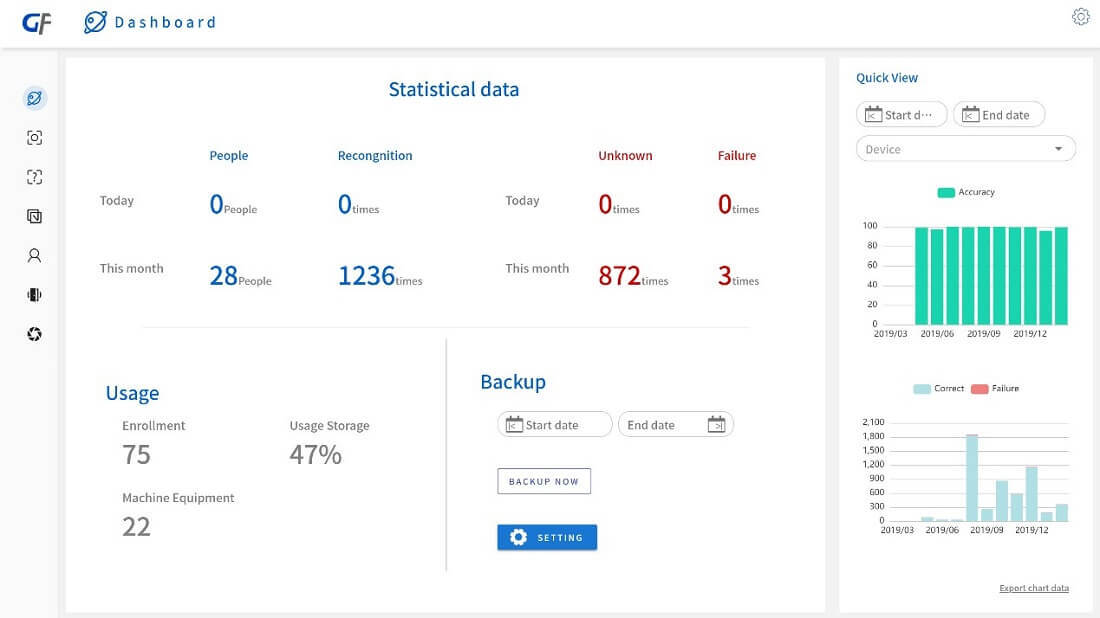
At the center of the AI Facial Recognition Solution is GFaceManager, which offers convenient control of the entire solution through a graphical user interface. It is also the only software that can access the encrypted biometric data.
AIO-M2:
At the front end of the solution is the AIO-M2, an all-in-one device that packs an infrared camera, a high dynamic range RGB camera, a 7-inch LED display, and a microprocessor in one manageable package. It has an IP rating of IP53, meaning it is suitable for both indoor and outdoor installations. Biometric data captured by the AIO-M2 are protected with encryption algorithms and centrally stored on the server, further enhancing data protection.
At the front end of the solution is the AIO-M2, an all-in-one device that packs an infrared camera, a high dynamic range RGB camera, a 7-inch LED display, and a microprocessor in one manageable package. It has an IP rating of IP53, meaning it is suitable for both indoor and outdoor installations. Biometric data captured by the AIO-M2 are protected with encryption algorithms and centrally stored on the server, further enhancing data protection.
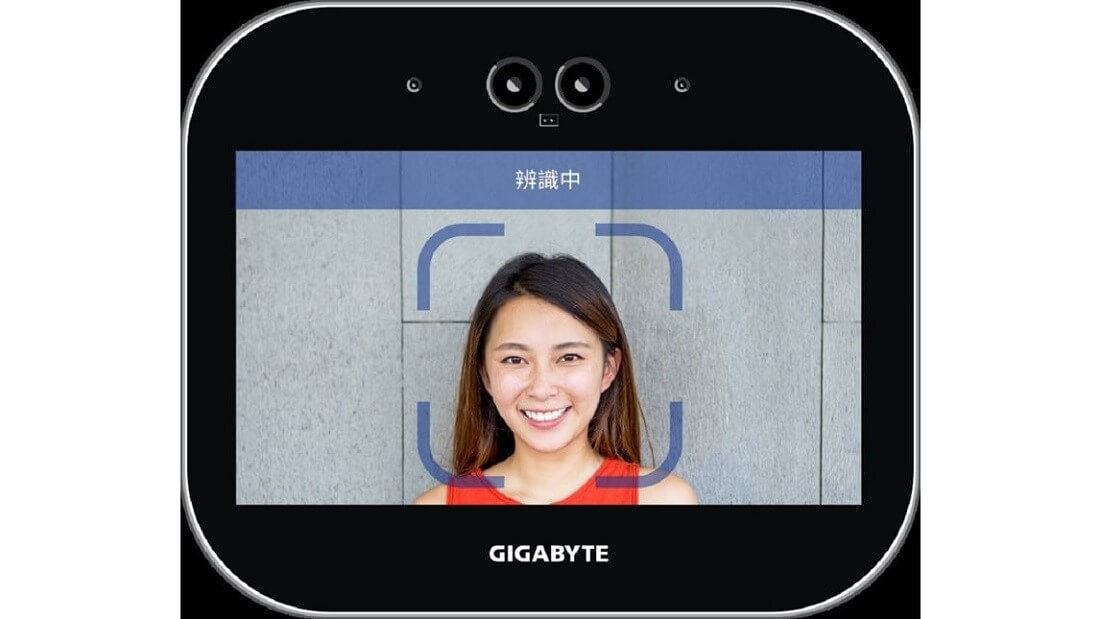
The front end of the solution is AIO-M2, an all-in-one device that combines a 7-inch display with dual IR and RGB camera lens. A user who has gone through the registration process can be recognized by the AIO-M2 in a matter of seconds.
Server:
The back end is a GIGABYTE server. For instance, Beixin Elementary uses a versatile R-Series Rack Server. The server fulfills three important functions: the database, where information is stored; the AI engine, which improves the solution’s speed and accuracy through machine learning; and the web server, which hosts the GFaceManager software. 《Glossary: What is Machine Learning?》
The back end is a GIGABYTE server. For instance, Beixin Elementary uses a versatile R-Series Rack Server. The server fulfills three important functions: the database, where information is stored; the AI engine, which improves the solution’s speed and accuracy through machine learning; and the web server, which hosts the GFaceManager software. 《Glossary: What is Machine Learning?》
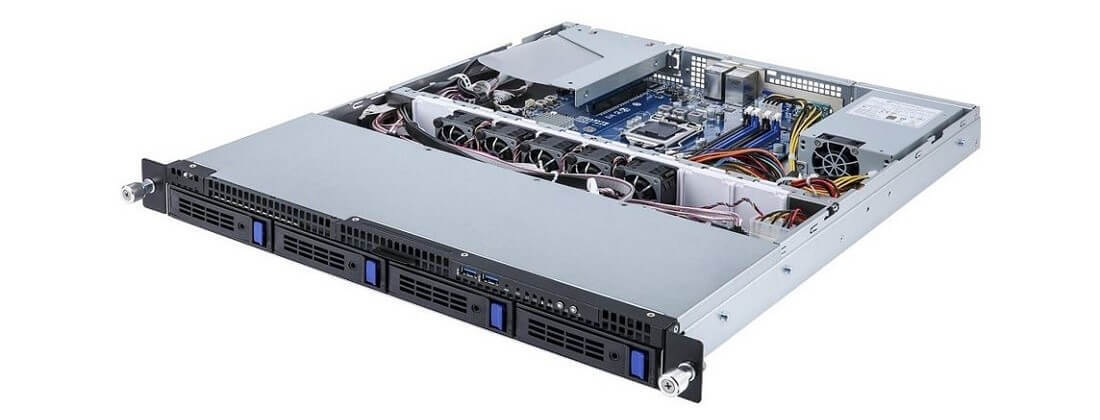
GIGABYTE’s R-Series Rack Servers were designed with versatility in mind, striking an optimal balance between efficiency and reliability. When serving as the back end of the AI Facial Recognition Solution, it fulfills three roles: the database, the AI engine, and the web server that supports the GFaceManager.
Learn More:
《Discover GIGABYTE's AI Facial Recognition Solution》
《More information about GIGABYTE's Rack Servers》
《Discover GIGABYTE's AI Facial Recognition Solution》
《More information about GIGABYTE's Rack Servers》
The AI Facial Recognition Solution's Three Benefits
One: 99.9% Precision vs. Over 2,000 Students
The AI Facial Recognition Solution can recognize students in a matter of seconds with an accuracy level of 99.9%. This is impressive because it is working off of a 1vN comparison model. To wit, the conventional method of facial verification uses 1v1 matching to check a face against a piece of identity document, such as a passport. The 1vN model has nothing to check against. It must recognize the faces of a couple thousand students while minimizing the false acceptance rate (FAR) and false rejection rate (FRR).
Two: Six Years of AI Training
GIGABYTE's solution harnesses the power of AI to continuously achieve greater speed and accuracy. Every time a student checks out books from the libraries, their facial model is updated. Gradual deviations in facial features are recorded. That is how the system recognizes the students through all six years of elementary school, even if they put on glasses or wear braces. Growing up alongside such an intelligent system is also a good way to educate children about the capabilities of AI.
Three: Edge Computing + Centralized Database
The AIO-M2 utilizes edge computing to recognize users even if internet connection is lost. While this is not pertinent to a library system, it becomes crucial when the solution is used to control access to a facility.
What's more, information is stored centrally on the GIGABYTE server, where encryption algorithms are used to protect the data. GIGABYTE also advised the schools to separate the backend servers into an independent network segment to further enhance data security.
Learn More:
Facial Recognition is the Start of an AI Environment
Inside the elementary schools that have deployed GIGABYTE’s AI Facial Recognition Solution, the response has been overwhelmingly positive. About 90% of all students have signed up to use the service. Other schools have contacted GIGABYTE to express their interest and evaluate whether the solution was suitable for them. Representatives from GIGABYTE have travelled around Taiwan to showcase the solution.
AI education has arrived. Using facial recognition to promote reading is a promising first step toward the further integration of AI tech in schools. Other potential applications include setting up a virtual fence to detect trespassers. In such a scenario, a prominent feature of GIGABYTE’s AI Facial Recognition Solution called anti-passback (APB), which prevents an unauthorized person from trailing an authorized person into restricted areas, will be very useful.
GIGABYTE Technology is helping to implement AI solutions across multiple industries. The banking sector and massive data centers can upgrade their security with facial recognition, to name a few examples. Immersing children in an AI environment helps them envision a world of possibilities, expanding their horizons and planting the seeds of tomorrow’s AI geniuses.